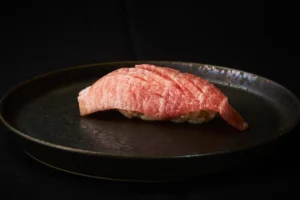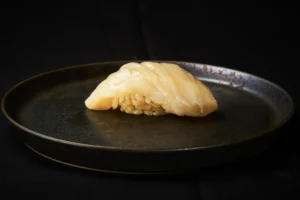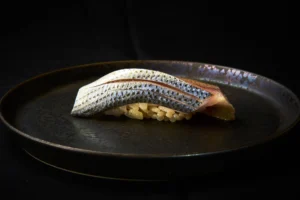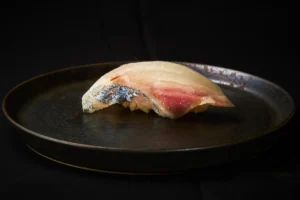

Written by Oku-Akasaka Sushi Tanji, an omakase counter in Akasaka, Tokyo.See the menu →
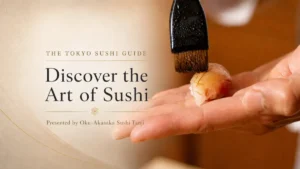
The amber sheen of zuke maguro was never about making the flavour louder. It began as a way to keep fish sound in a city with no refrigeration. Here we look at how the nikiri (soy simmered with sake to take the edge off) for the marinade is built, what a few minutes of steeping does compared with half an hour, why akami (lean loin) is handled differently from chutoro (medium-fatty tuna). It is the story of keeping wisdom turning into flavour design.
In short
Zuke is the Edomae technique of steeping tuna in nikiri soy so that seasoning enters the flesh. It arose as a way to keep fish before refrigeration: salt in the soy draws out moisture, firming the flesh while concentrating its savour. Most sushi today gives it a few minutes up to a dozen or so, a treatment that suits lean akami especially well.
What you will learn
- Where zuke came from, plus how its role moved from keeping fish to seasoning it
- How the nikiri soy marinade is built, with the reason for simmering it
- What a few minutes, ten minutes, half an hour each do to colour and firmness
- Why akami, chutoro, otoro (the fattiest belly) each take to zuke differently
- How zuke differs from ageing, plus how the two can be layered
- What to do about soy sauce when a piece of zuke arrives
Zuke: seasoning that arrives by steeping
Zuke is Edomae work. The tuna is cut, then laid into tare, a marinade of soy sauce loosened with sake plus mirin, so that flavour enters from the surface inward. At the counter you may hear it voiced as ‘dzuke’. Unlike a brush of soy across the top, steeping carries the seasoning further in for every minute it lasts.
The first thing you notice is colour. Steeped tuna turns from amber to a reddish brown at the surface while the core of the slice keeps its original red. That colour comes from the soy; it says nothing about the age of the fish.
Keeping wisdom from an age without refrigeration
When tuna first came into the streets of Edo, there was little to chill it with. Lean akami turns colour quickly, so it could not simply be left to sit. Steeping it in soy drew moisture from the surface, which is said to have bought the fish more time. Whole blocks were sometimes left for several hours or overnight, far longer than anything served over rice today.
Fatty toro, by the same accounts, spoiled fast enough to be a nuisance. Part of why Edomae craft grew so refined around akami is that akami was the everyday fish. A method begun for keeping ended up as a method for building savour.
The marinade is simmered before it is used
A tare begins as soy sauce with sake plus mirin, brought to the heat so the alcohol cooks away. This simmering, nikiri, rounds the edge of the sake while settling its aroma, so the seasoning enters more gently than raw soy would. Some kitchens add a little kombu or katsuobushi dashi to soften the salt.
- Simmer the tareSoy sauce with sake plus mirin, given heat to take off the edge. Cooled before use.
- Blanch the surfaceA moment in boiling water, then straight into ice water to firm the outside. Some kitchens leave this out.
- Cut from the blockCutting to the size of the finished piece first makes the timing easier to read.
- Lay it in the tareRather than watching a clock, the piece comes out when its colour and firmness look right.
- Wipe away the excessThe surface is blotted lightly, then the piece is formed with shari (seasoned rice).
A few minutes and half an hour give you different fish
Steeping changes texture as much as intensity. A brief turn leaves the scent of akami intact; a long one carries soy to the core for a firmer bite. Short steeping is the norm now, with many chefs keeping it inside the space of a few to fifteen minutes.
| Time in the tare | What happens to the flesh | Cuts and uses it suits |
|---|---|---|
| A few minutes | Seasoning sits on the surface; the scent of akami comes forward | Thinly cut akami, chutoro |
| Around ten minutes | Lightly firmed, with soy plus fish reading as one savour | Akami nigiri |
| Thirty minutes or more | The colour turns amber; seasoning reaches close to the centre | Sinewy cuts, rolls, small rice bowls |
| Several hours to overnight | Moisture leaves, the flesh hardens, salt steps forward | The keeping method of an age without refrigeration |
The same tare behaves differently depending on thickness plus the amount of fat. Reading the colour of the cut face is a surer guide than any number of minutes.
Suited to akami, less so to otoro
Zuke sits most happily with akami. With little fat in the way the tare enters readily, so the amino acids of the soy lay over the savour the tuna already carries. In chutoro the fat forms something of a wall, so the same span of time often leaves the seasoning short; a thin cut given a brief steeping suits it better.
Otoro is rarely given to zuke. More often it is formed as it is, sometimes passed briefly over a flame to bring the fat forward. Sinewy sections are occasionally steeped, then chopped fine for rolls or a small rice bowl. Within a single fish, the parts take to zuke in their own ways.
Zuke and ageing pull in opposite directions
Both zuke and ageing increase savour, though they work from opposite ends. Zuke brings soy in from outside while drawing moisture out, sharpening the outline. In ageing, the fish’s own compounds change over time, so savour builds from within.
This is why akami that has gained depth through ageing can end up overloaded when steeped for long. At a counter such as Sushi Tanji, where the Edomae vocabulary of curing, steeping, plus nikiri is set alongside ageing, zuke is less a way of keeping fish than a way of composing flavour around the fish of that day. Shortening the time counts as one judgement; choosing not to steep at all belongs to the same judgement.
Lean tuna in July, one piece of zuke
July tuna is usually spoken of as a time when the fat runs modest. The thick otoro of winter bluefin is not much to be hoped for; in its place the outline of akami shows clearly. A short steeping gives a core to akami that can taste watery, which sits well with summer shari, seasoned a touch more sharply with vinegar.
When zuke arrives, it is ready as it is, with no need for soy. The seasoning is already inside, so anything added tends to push the salt forward. Fingers or chopsticks are equally welcome, plus there is no need to hurry about the order of things. Our reading list takes up other ways of looking at tuna, including the difference between akami and chutoro.
Frequently asked questions
May I dip zuke maguro in soy sauce?
It tastes more settled without. Zuke arrives with soy already inside the flesh, so more of it raises the salt while hiding the scent of the tuna. If a piece leaves you wanting something, you are welcome to say so to the chef along with how firm you like the rice.
Are zuke and ageing the same thing?
They are different work. Zuke brings soy in from outside while drawing moisture out; ageing is the fish’s own compounds shifting over time so that savour deepens. Some kitchens combine the two, though flesh that has aged well tends to be given only a brief steeping.
Does zuke maguro look dark because it is past its best?
The colour comes from the tare. Steeping turns the surface from amber to a reddish brown while the inside of the cut keeps its original red. It is a different quality of colour from the faded look of oxidised akami; the surface of zuke carries a gloss.
How long is a piece usually steeped?
A few minutes up to a dozen or so seems to be the norm for nigiri today. Thickness plus the amount of fat change how the seasoning enters, so the usual approach is to watch the colour of the cut face along with its firmness rather than the clock. In the age before refrigeration, several hours or a whole night was not unusual.
Is the filling of tekkamaki (tuna roll) zuke maguro?
It varies by house. Some use steeped akami; others roll akami as it is, without the tare. There are also kitchens that steep the sinewy cuts, then chop them fine for the roll. If you are curious, asking what is inside on the day tends to open up a good conversation.
From the guide to the counter
Taste it at our eight-seat counter in Oku-Akasaka.
Classic Edomae craft with careful modern aging – served piece by piece, with English guidance for overseas guests.
Reserve at Sushi Tanji Explore The Tokyo Sushi Guide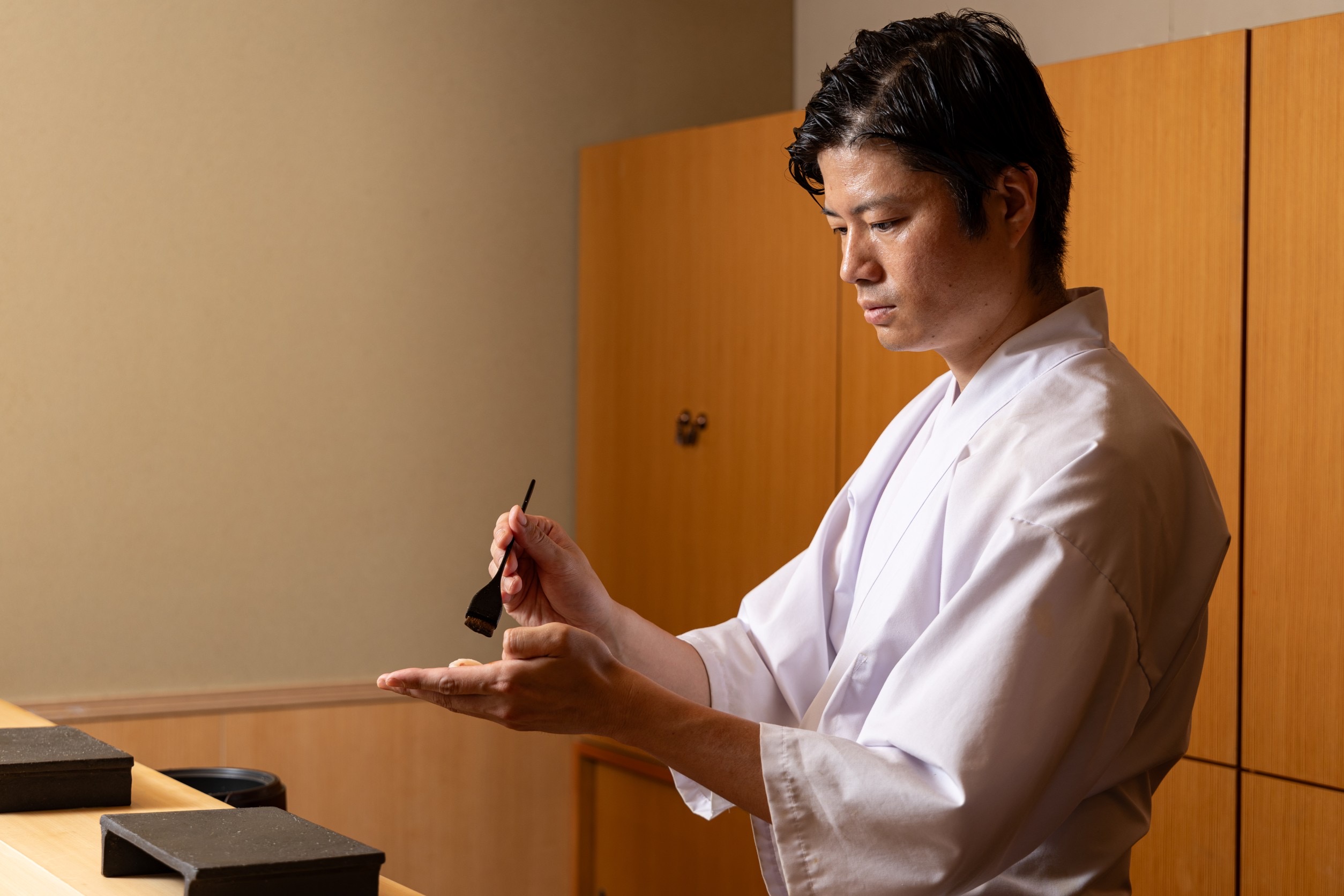
Reviewed by
Tatsuo TakadaHead chef and owner of Sushi Tanji. Trained in the Edomae tradition and rooted in Kyushu, he leads the eight-seat omakase counter in Oku-Akasaka, Tokyo, and reviews The Tokyo Sushi Guide.