

Reviewed by Tatsuo Takada (owner-chef, Oku-Akasaka Sushi Tanji)
Part of The Tokyo Sushi Guide Updated Reading time about 6 minutes See the menu →
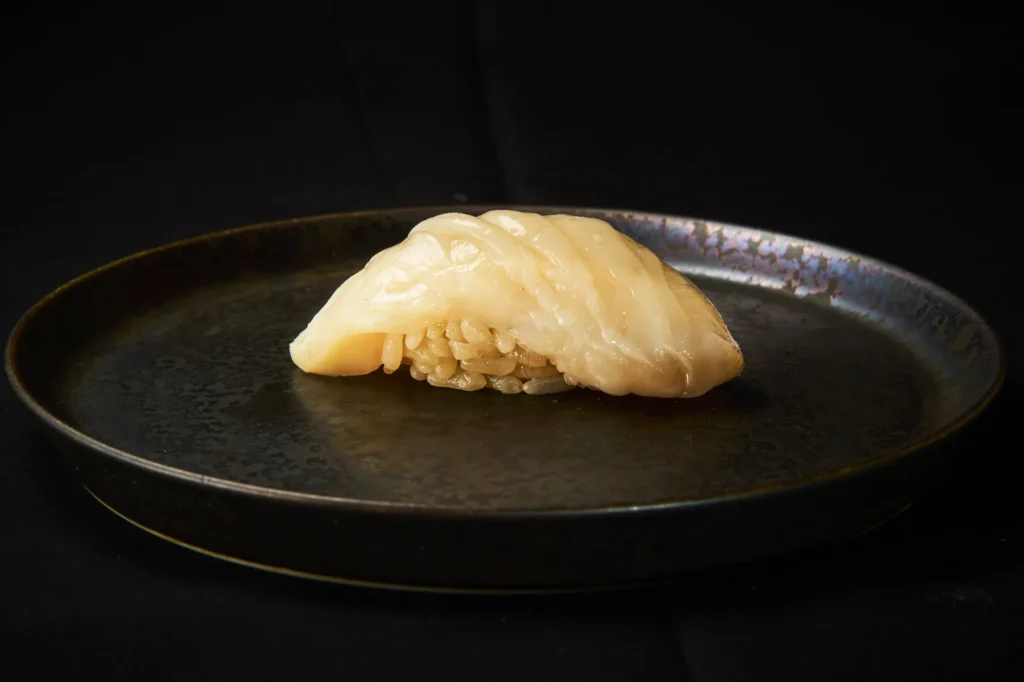
The vinegar in shari, the seasoned rice, is not simply a choice between red and clear. Some counters blend the two; salt, too, need not be a single ingredient. Following the rhythm of Edomae preparation, this piece looks at what akazu (red vinegar aged from sake lees) and rice vinegar each carry, why a soft-edged salt is set beside a slightly sharper one, then how a shari is designed to meet aged fish as one.
In short
Shari made from a blend rests on the aged aroma and depth of akazu, while rice vinegar draws the outline of its acidity. Salt works the same way: one with soft edges receives the sweetness of aged fish, while one with a little more point keeps the finish short.
What you will learn
- How akazu and rice vinegar differ in aroma, colour and the way their acidity rises
- What changes when the two vinegars are brought together
- The division of labour between a soft-edged salt and a slightly sharper one
- Why shari too sharp or too mild unsettles the balance with aged fish
- How temperature and grain are handled from the pot to the moment of forming
- What to notice in July when you turn your attention to the rice
Akazu and rice vinegar do different work
Akazu is made by ageing sake lees. It carries a brownish colour, a rounded acidity and a sweet aroma close to mirin (sweet cooking sake). Rice vinegar is made from rice, pale in colour, its acidity clear and quick to rise. When shari looks brown at the counter, nothing has been added for colour: that is the vinegar itself.
Some Edomae houses build their shari on akazu alone; others work only with rice vinegar. Neither is more correct than the other. What the rice needs depends on which fish is served and how long it has been allowed to rest.
| Vinegar | Aroma and colour | How the acidity arrives | Where it tends to suit |
|---|---|---|---|
| Akazu | Aged aroma from sake lees, pale brown | Gentle and rounded | Zuke (soy-marinated fish), rested red-fleshed fish, work finished with nikiri glaze |
| Rice vinegar | Quiet aroma, pale colour | Quick to rise, clean | White-fleshed fish, hikarimono (silver-skinned fish), the sweetness and bite of shellfish |
The choice to blend
Akazu alone gives depth and an aged aroma, though the outline can soften more than intended. Rice vinegar alone cuts cleanly, yet against the concentration of rested fish the foundation can feel light. Blending the two lets one vinegar carry the base of aroma while the other draws the edge of acidity.
Sushi Tanji, in Oku-Akasaka in Tokyo, also works with a shari of akazu blended with rice vinegar. The proportions are not made public. A blending ratio sits close to the heart of a house’s work, so it is usually kept quiet.
Two salts, used differently
With salt, quality tends to show more plainly than quantity. A salt with soft edges brings sweetness and savour forward, rounding the first impression on the palate. A salt with a little more point lifts the outline of a flavour, keeping the finish short. The same measure of either will leave a different impression of a single piece of nigiri (hand-formed sushi).
The house works with two salts of exactly this contrasting character. Sugar is another matter: some kitchens add a little; others leave it out entirely.
Salt speaks after you swallow
Salt does its work less at the first touch than after the fat of the fish has spread. When a neta (the topping) leaves a long, rich trail, a salt with the strength to draw a line beneath it lets you meet the next piece freshly. Counters where a dozen or more pieces never grow heavy usually owe that to careful thought about the finish.
The rice: two varieties, blended 7 to 3
Before vinegar and salt comes the rice itself. As of October 2026, our shari is made from our own blend of 2025-harvest rice: Hatsushimo from Gifu Prefecture and Musubi no Kami from Mie Prefecture, in a ratio of 7 to 3.
Hatsushimo has large, well-defined grains, a pleasant firmness and a clean, light flavour. Musubi no Kami brings a soft, plump texture, a refined sweetness and a moderate stickiness. Together they give rice that comes apart grain by grain in the mouth while keeping the gentle, natural sweetness of the rice.
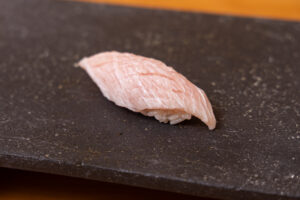
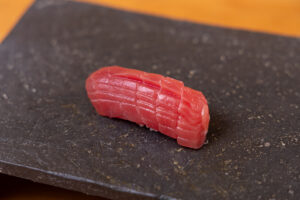
The blend is there to bring out the umami of our aged fish and the delicate sweetness of its fat, so that fish and rice become one in the mouth.
Aged fish and shari, meeting as one
As fish rests, moisture leaves it, savour grows dense, then the flavour begins to arrive more slowly. If the acidity of the shari is too strong against that change, the outline of the fish disappears; if it is too faint, the whole piece sinks. The more a house builds on ageing, the finer its adjustments to the rice become.
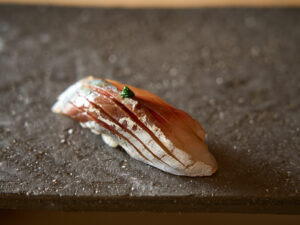
Here the classic Edomae repertoire of curing, marinating and nikiri glazing meets ageing informed by the Tsumoto method of bleeding and dressing, with resting time and temperature judged species by species. The shari is the other half of that design, shaped to receive what the fish has become.
Temperature and grain settle the rest
Even once the vinegar blend and the salts are settled, handling changes the taste. More often than one might expect, temperature and the separation of the grains shape the impression in the mouth more than any ratio of vinegar.
- Cook it a little firmMany kitchens hold back the water so the grains stay distinct.
- Fold in the vinegar while hotThe seasoned vinegar goes in while the heat of the pot remains, with a wooden tub drawing off what moisture is left.
- Cut it, then let it settleThe rice is cut rather than stirred so the grains keep their shape, cooling towards the warmth of the hand.
- Form with few movementsShaped with air still inside, the rice loosens gently on the tongue.
Shari at body temperature melts the fat of the fish sooner than cold rice does. It loosens before you chew, so vinegar, salt and fish open at the same moment. This overlap in time is usually what people mean by unity.
July at the counter, with the rice in mind
July brings the first shinko (young gizzard shad) of the year, alongside kisu (sillago), makogarei (marbled flounder) and steamed awabi (abalone). Vinegar-cured work grows more frequent and heat shifts the way the mouth reads flavour, so the acidity of the shari can seem more forward than usual. This is the season when the roundness of akazu earns its place.
There is no set way to enjoy any of this, so please feel at ease. For the first piece alone you might turn your attention away from the fish, towards the warmth of the rice and the trace of salt left after you swallow. The outline of that day’s preparation begins to show. The seasonal pieces may offer a few further clues.
Frequently asked questions
Is shari made with akazu sour?
Beside rice vinegar, akazu is rounder in its acidity, with a sweetness in the aroma. The depth of the colour suggests something strong, though on the palate it usually reads as gentle.
Is something mixed in to make the shari brown?
Nothing is added for colour. That is simply the shade of akazu, which comes from aged sake lees. Where rice vinegar is blended in, the colour tends to appear paler than with akazu alone.
Will a chef share the ratio of the blended vinegar?
Most houses keep the proportions to themselves, since they sit at the heart of the preparation, so it is kinder not to press. Questions of another kind are usually welcome: whether akazu is in the blend at all, how the acidity shifts with the season.
What temperature is the shari?
Most houses settle it around the warmth of the body. At that range the fat of the fish melts readily, while the formed rice loosens with ease.
Is it unusual for a house to use two salts?
Plenty of kitchens work with one alone. Combining salts of differing character is simply one way to adjust the softness of the first impression separately from the tautness of the finish.
From the guide to the counter
Taste it at our eight-seat counter in Oku-Akasaka.
Classic Edomae craft with careful modern aging – served piece by piece, with English guidance for overseas guests.
Reserve at Sushi Tanji Explore The Tokyo Sushi Guide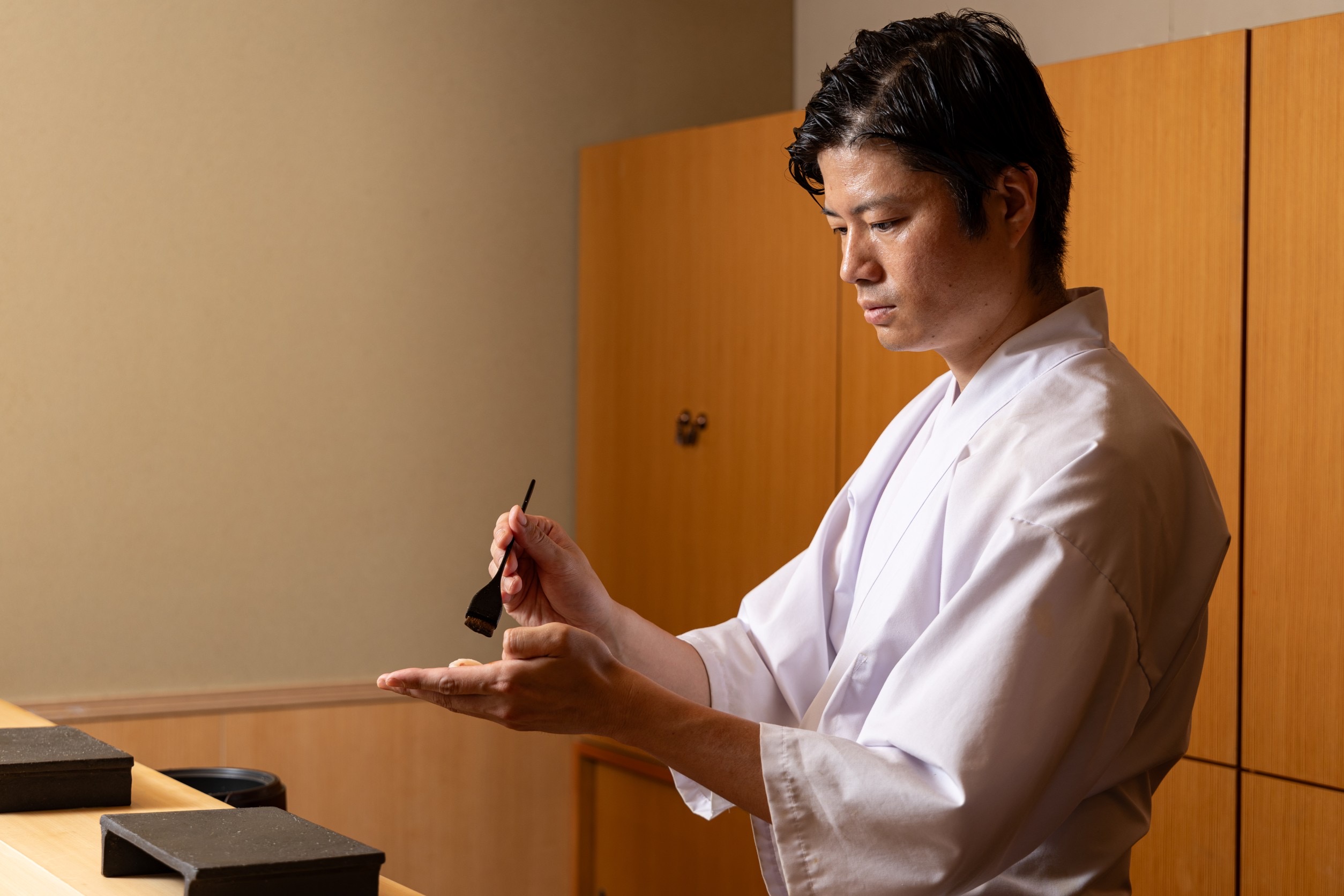
Reviewed by
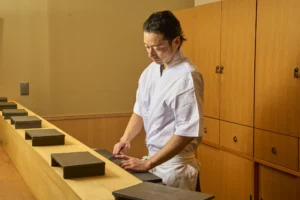
Tatsuo TakadaHead chef and owner of Sushi Tanji. Trained in the Edomae tradition and rooted in Kyushu, he leads the eight-seat omakase counter in Oku-Akasaka, Tokyo, and reviews The Tokyo Sushi Guide.