Reviewed by Tatsuo Takada (owner-chef, Oku-Akasaka Sushi Tanji)
Part of The Tokyo Sushi Guide Updated Reading time about 6 minutes See the menu →
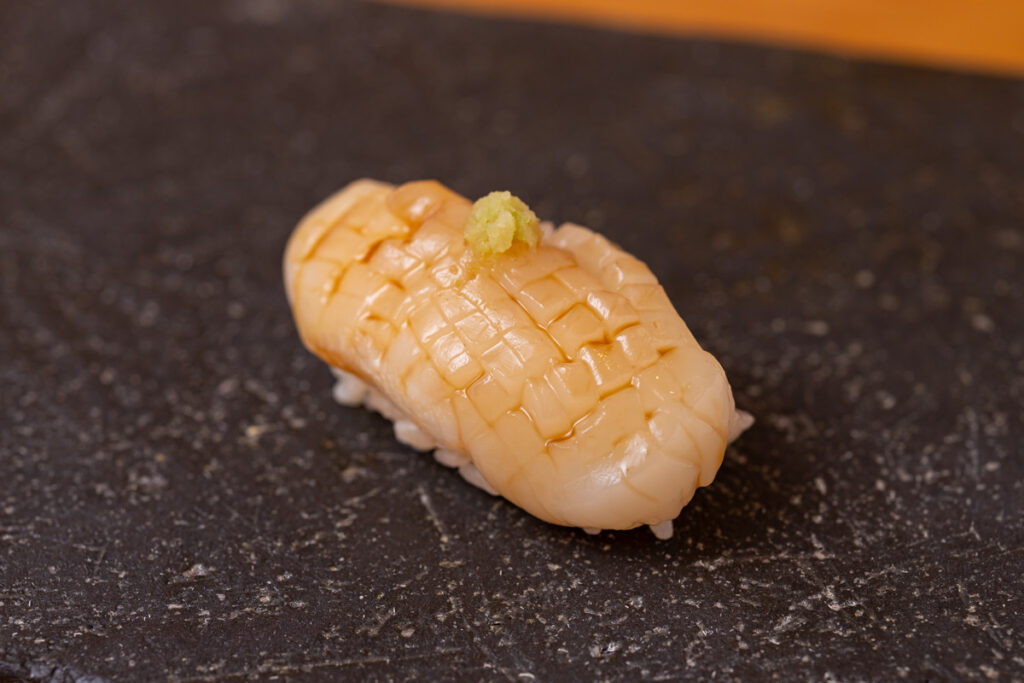
By the time a fish bled by the Tsumoto method reaches the cutting board of a sushi shop, it has passed through the hands of a fisherman, a specialist handler as well as a broker at the market. Bleeding is not, on its own, a technique that makes a fish delicious. It settles the fish into a state where it can be kept over time, then hands it on to the next pair of hands. What follows traces that chain of hands, along with the way knowing who prepared a fish and when it was done changes the judgement of ageing.
In short
A single piece of sushi carries the work of the fisherman who landed it, the handler who bled and prepared it, the broker who judged it plus the chef who shapes it at the counter. Bleeding by the Tsumoto method sits partway along that run of handovers. The more that is known about who prepared a fish, when it happened, in what manner, the more precisely the resting days can be judged.
What you will learn
- How many pairs of hands touch a single piece of nigiri, plus what each of them does
- Why bleeding by the Tsumoto method sets the conditions that ageing depends on
- The difference between drawing the blood from a fish and bringing that fish to its best
- How a record of preparation guides the choice of how long to rest a fish
- Which August fish reward resting, along with which are better served at once
- How to ask about a fish's origins while sitting at the counter
Who Bled This Fish?
Most of the fish served at a sushi counter was not caught by the person who shapes it. It is taken from the sea, dispatched at the port, chosen at the market, then held in the shop’s refrigerator while time does its quiet work. Behind a single piece of nigiri there are usually four or so pairs of hands. If any one of them works carelessly, the last pair cannot recover what was lost. A good deal of what separates one piece of sushi from another is settled well before the moment of shaping.
How Often Does One Fish Change Hands?
- The fisherman lands itHow a fish is dispatched in its first moments sets the broad shape of its firmness plus how much blood is left behind.
- A handler bleeds it, then prepares itUsing the Tsumoto method or something close to it, blood and fluids are drawn out so the fish can be entrusted to time.
- A nakaoroshi (intermediate wholesaler) reads it, then passes it onWithin one species no two fish are alike; the broker picks the ones whose flesh suits what a given shop is after.
- The sushi chef judges it, then shapes itFollowing the change from day to day, the chef cuts each fish on the day it shows best.
This order can shift with the route a fish travels. Preparation is sometimes finished at the port, sometimes at the market. Whichever path it takes, a fish always moves from one person’s hands into another’s.
The Tsumoto Method Is Bleeding, Not Ageing
Tsumoto-shiki (the Tsumoto method) uses water pressure to flush the blood remaining in a fish’s vessels. It was devised by a specialist in the preparation of fish. Blood is where spoilage tends to begin, so once it is gone a fish can be held at low temperature for far longer. The step is not the answer to ageing. It is the doorway that makes ageing possible.
A fish shaped in haste, straight after bleeding, has little umami to give yet. What matters is the temperature it rests at afterwards, together with the number of days it is allowed. At an Edomae counter, meaning the Tokyo style built on preparing fish rather than simply slicing it, the daily work of touching each fish, following the change in its firmness as well as its scent, carries on without pause. At Sushi Tanji, bleeding and preparation are means rather than ends: the work is to give each fish the ageing it asks for, then to serve it at its finest moment.
The Work of the Shitate-nin, the Fish Handler
There are people whose whole craft is the preparation of fish. They take on the dispatch, the bleeding, the shinkei-jime (nerve spiking) plus the storage, then send the fish onward with a note of who handled it and when. A fish arriving in a kitchen with that much still known about it is not the ordinary case. A single fish’s history tends to thin out as it passes through the market.
This counter works directly with handlers who practise the method, among them those who learned it at its source. Knowing whose work you have in front of you matters in the daily craft rather than in anything claimed about it. If the hand is known, the habits of that hand can be read. If the habits can be read, the right number of resting days comes into view sooner. The thinking behind the shop grows out of exactly that accumulation.
What It Means to Know Whose Hands Prepared a Fish
| What is known | What it reveals | How it bears on ageing |
|---|---|---|
| The date and hour of dispatch | How much time has passed as rigor sets in, then eases | The starting point for resting is never guesswork |
| Whether the fish was bled or nerve-spiked | How much blood or fluid remains in the flesh | A sense of how long it can be held at low temperature |
| The size of the fish plus the waters it came from | The likely fat content along with the character of the flesh | The same number of days can be read as a different result |
| The person who prepared it | The habits particular to that person’s work | Comparison with earlier fish from the same hands |
Even with all of it known, some fish remain difficult to call. What changes is the nature of the hesitation. Instead of opening the refrigerator, pressing a finger into the flesh, wondering whether this one is still sound, the question becomes when it will show at its best. Instinct is not retired. It simply goes to work further along.
August Fish, plus a Question Worth Asking
August brings warm water; fish turn quickly. That is precisely why the treatment a fish receives in its first hour shows up so plainly at the counter. Firm-fleshed fish such as tachiuo (cutlassfish) along with shima-aji (striped jack) can be entrusted with a few days, the umami stepping forward as they rest. Others, shinko (young gizzard shad) among them, are finished in a single day’s work then served the same evening. Resting is not something every fish is asking for.
You Are Welcome to Ask
Many guests ask where today’s fish came from. It is quite all right to take one step further: who prepared this fish? A shop with an answer will give it and once it comes the number of hands behind that single piece begins to show. There is no need to prepare yourself for the question. There is no wrong way to ask it.
Frequently asked questions
How is a fish bled by the Tsumoto method different from one that is not?
The main difference is how much time it can be given. Blood plus residual fluids hasten spoilage, which limits the days a fish can rest. A bled fish sits comfortably at low temperature for longer, so there is more room to wait while ageing draws out its umami. It does not become delicious at the moment of bleeding. The difference is made afterwards, in temperature along with judgement.
Does aged fish take on a fishy smell?
Most of that smell comes from blood or fluids left behind as they change over time. Bleeding plus careful preparation reduce the cause at its source; the management of temperature together with days does the rest. At an Edomae counter it is usual to touch the fish daily to read its condition, then to hold back anything judged to have passed its moment.
Once a fish has been bled, can it be rested indefinitely?
It depends on the species as well as the individual fish. Firm white-fleshed fish or oily silver-skinned ones may be held from a few days to about a week, while others such as shinko are finished without any resting at all. Fat content, size plus the state of the fish at dispatch all shift the suitable window, so it is more practical to read how far a particular fish has travelled than to count the days.
Is it impolite to ask about a fish's origin or preparation at a sushi counter?
When there is a lull, most shops welcome it. Asking briefly in the pause after you have finished a piece, rather than mid-sequence, tends to let the conversation open naturally. Ask how a fish was prepared rather than only where it came from, then the talk may widen out into how the evening’s courses were built.
From the guide to the counter
Taste it at our eight-seat counter in Oku-Akasaka.
Classic Edomae craft with careful modern aging – served piece by piece, with English guidance for overseas guests.
Reserve at Sushi Tanji Explore The Tokyo Sushi Guide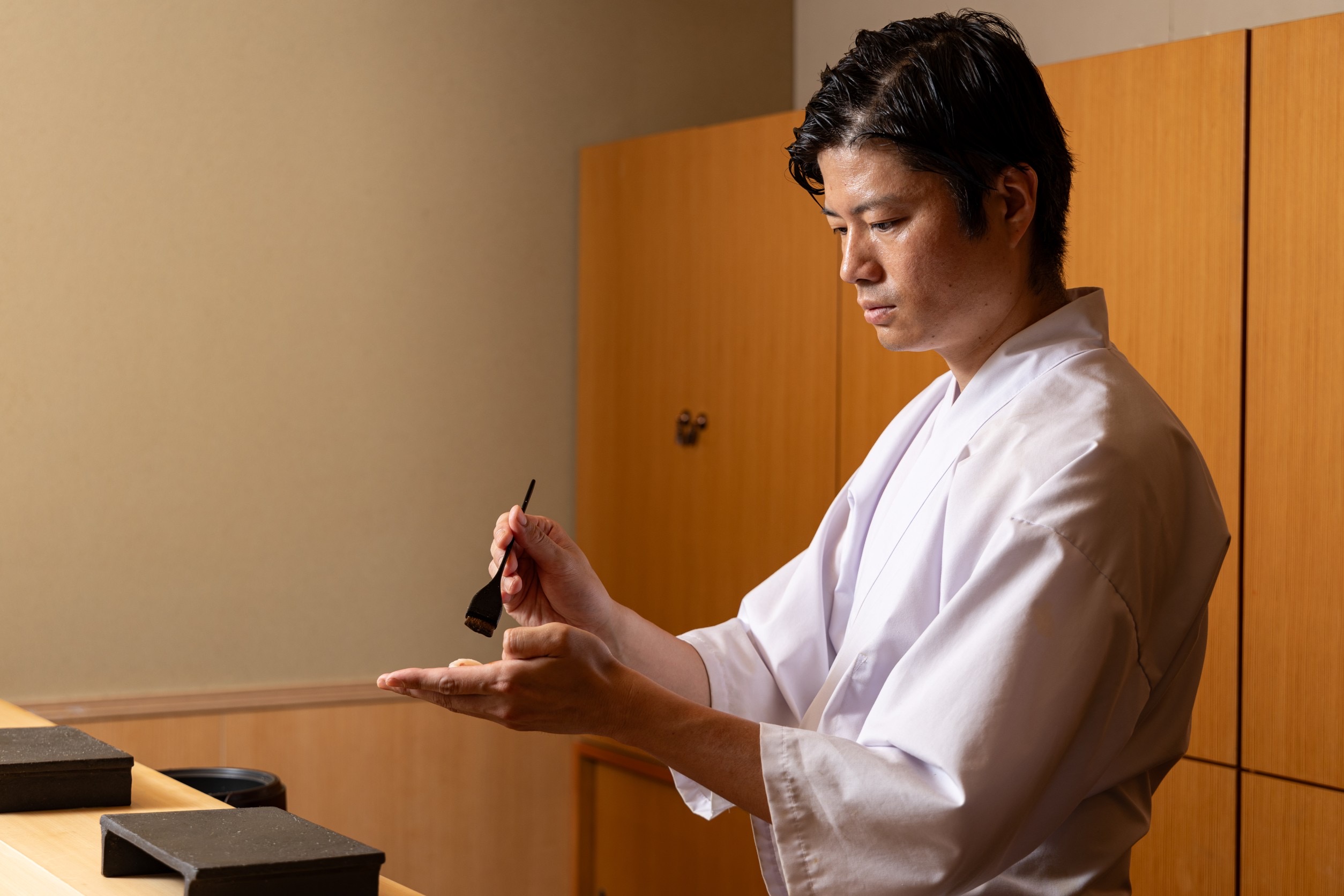
Reviewed by
Tatsuo TakadaHead chef and owner of Sushi Tanji. Trained in the Edomae tradition and rooted in Kyushu, he leads the eight-seat omakase counter in Oku-Akasaka, Tokyo, and reviews The Tokyo Sushi Guide.