
Written by Oku-Akasaka Sushi Tanji, an omakase counter in Akasaka, Tokyo.See the menu →
In October 2026, our owner Tatsuo Takada received two-star recognition in tsumoto-shiki, the Tsumoto method. Around the same time, the rice we use for our shari changed too. Aged fish, and the rice that receives it: here are the two stories behind each piece at Oku-Akasaka Sushi Tanji.
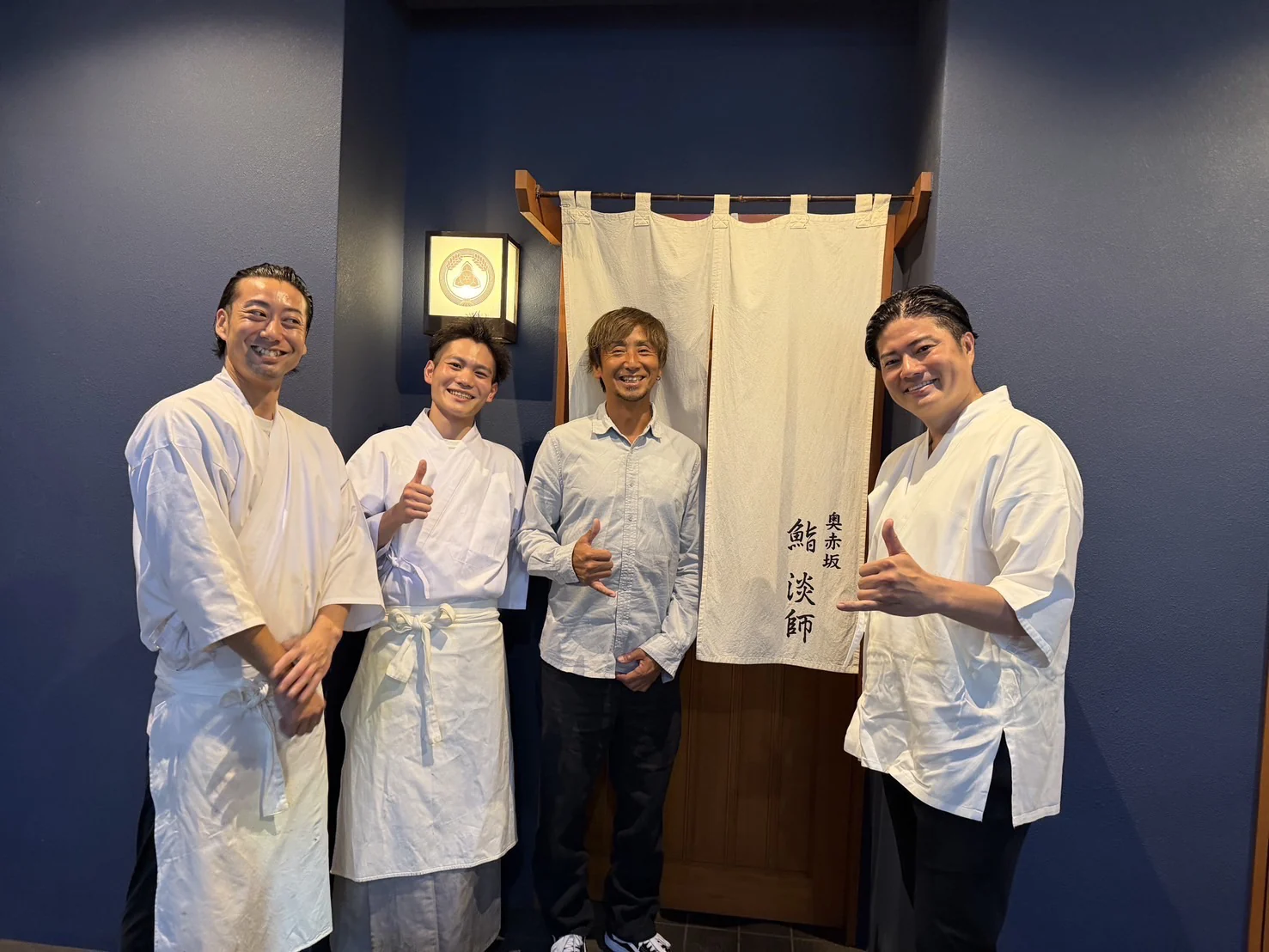
Two-star recognition in tsumoto-shiki
Tsumoto-shiki is a technique devised by Mitsuhiro Tsumoto for drawing the blood from a fish using water pressure, often called the ultimate bleeding method. Our chef began instruction at Toyosu Market in August 2026 and received two-star recognition in October.
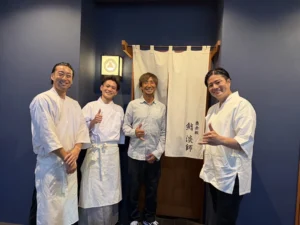
He is listed as the chef of Oku-Akasaka Sushi Tanji among the practitioners recognised at two stars and above on the official Tsumoto-shiki website (tsumotoshiki.com, recognised practitioners).
What our chef learned on the way to two stars
Tsumoto-shiki recognition goes up to three stars. From August to October 2026 our chef took the course, passed the examination and received two-star recognition. Here is what he learned while studying and practising for the examination, summarised from his own words.
- How a fish dies changes its flesh. When a fish struggles before it dies, the ATP (energy) in its muscle is used up more easily, which affects rigor mortis and texture. Ikejime stuns the fish quickly through the brain, so less muscle movement and less ATP are wasted. Freshness depends not only on the time since death, but on how the fish died.
- Nerve destruction does not create umami. Destroying the spinal cord holds back reflexes and muscle contraction after death and reduces wasted ATP. It keeps the substances that become umami and makes the changes that follow easier to manage.
- The blood is pushed out with water pressure. Once the heart has stopped, blood cannot be circulated out. Instead, the blood vessels are used as channels for water, and the remaining blood is pushed out by pressure. From the gill side, water runs through the arteries to a wide area of the body; from the tail side, it helps clear the remaining blood along a different route. The two are used according to the state of the fish. It is not a matter of force: too much pressure can damage the vessels and the flesh.
- Time cannot be turned back. Blood can sometimes be removed even after rigor mortis, but clotted blood does not dissolve easily in water, and freshness that has been lost does not return. The Tsumoto method is about reading the state of the fish in front of you and removing the causes of decline as far as possible.
- Ageing does not always make a fish better. After death, ATP breaks down into compounds such as inosinic acid, and during ageing the amino acids change too. The best moment depends on the species, the individual fish, how it was killed and the temperature.
- Chilling matters as much as bleeding. Cooling holds back microbes and deterioration. Yet for some species and conditions, chilling too fast or too cold can affect how the muscle contracts. The aim is not simply to make the fish cold, but to keep it at a temperature that suits it.
- Bleeding alone does not prevent fishy smells. Blood left in the fish can take part in the oxidation of fat and cause odour and discolouration. Trimethylamine (TMA), behind the “fishy” smell, is formed mainly by bacteria, so hygiene, handling of the innards and temperature control all have to work together.
Until now, my attention went to each technique on its own: killing the fish, bleeding it, destroying the nerve, ageing it. Through this study I understood again that every step has a reason, and that each one is connected to the next.
Tatsuo Takada, owner
We will keep reading how each species and each individual fish differs, and manage every stage from killing and bleeding to chilling and ageing as one, so that each fish reaches you at its best.
How we age our fish
Apart from tuna and sea urchin, we buy our fish mainly from people who work with the Tsumoto method: its creator Mitsuhiro Tsumoto, and two specialists recognised in the Tsumoto method. The fish is dispatched, its nerve removed and its blood drawn down to the fine vessels; the gills and innards are taken out, and it reaches us vacuum-packed and kept cold.
We then age each fish for a period and at a temperature suited to its species. For how bleeding makes ageing possible, see why bleeding a fish lets it age.
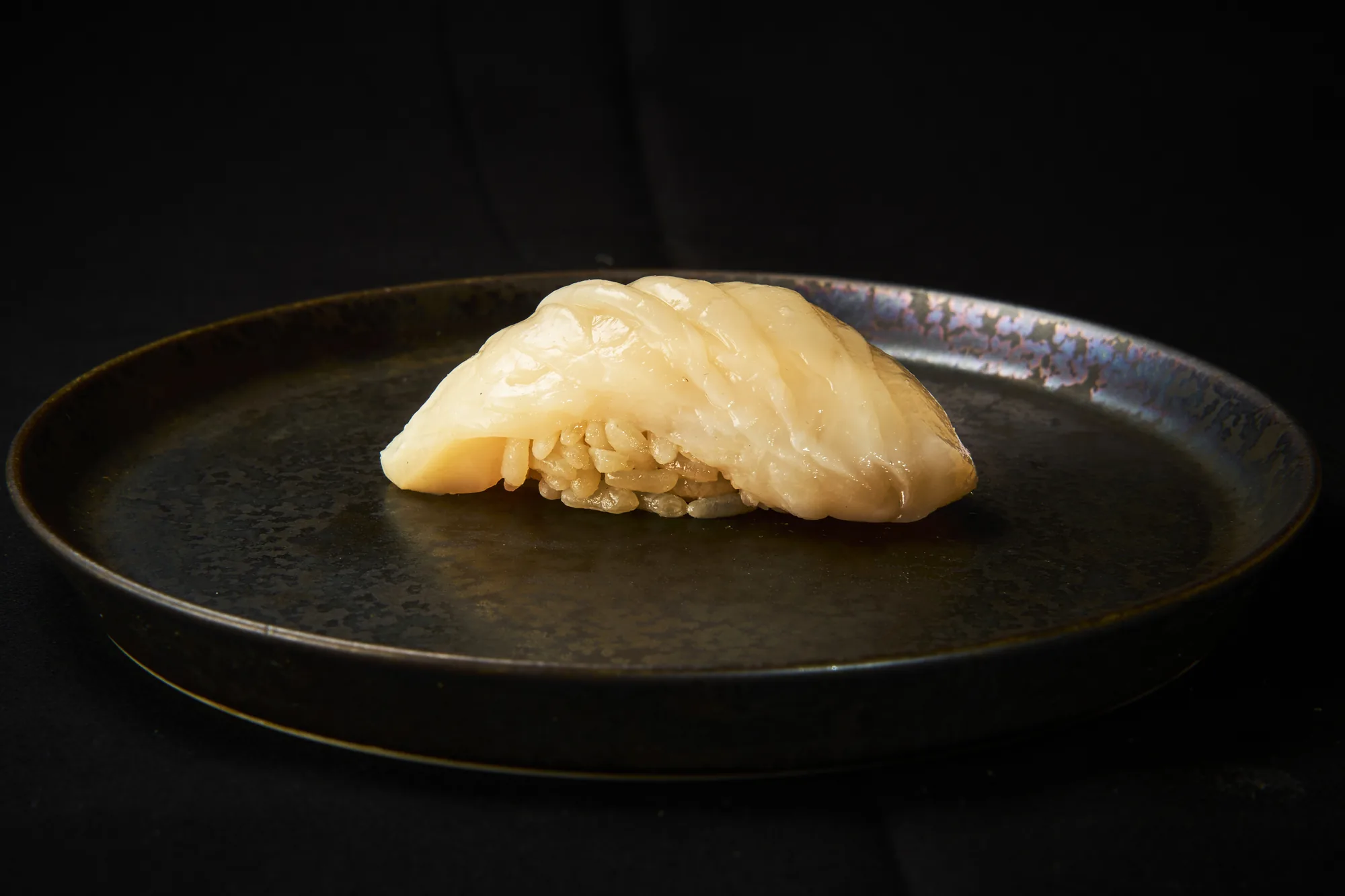
Our rice: Hatsushimo and Musubi no Kami, blended 7 to 3
We are particular about the rice in our shari, too. We currently use our own blend of 2025-harvest rice: Hatsushimo from Gifu Prefecture and Musubi no Kami from Mie Prefecture, in a ratio of 7 to 3.
Hatsushimo has large, well-defined grains, a pleasant firmness and a clean, light flavour. Musubi no Kami brings a soft, plump texture, a refined sweetness and a moderate stickiness. Together they give rice that comes apart grain by grain in the mouth while keeping the gentle, natural sweetness of the rice.
We season it with a blend of red vinegar (akazu) and rice vinegar, and use two salts of different character. More on how our shari is put together: our shari, with two vinegars and two salts.
So that fish and rice become one
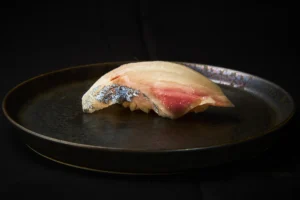
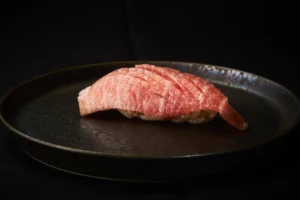
The blend is there to bring out the umami of our aged fish and the delicate sweetness of its fat, so that fish and rice become one in the mouth. The handling and ageing of the fish, and the shari, are one design for each piece.
Come and taste aged fish over our new shari at the counter. Reservations are available online via TableCheck.