

Reviewed by Tatsuo Takada (owner-chef, Oku-Akasaka Sushi Tanji)
Part of The Tokyo Sushi Guide Updated Reading time about 6 minutes See the menu →

In Edo-style nigiri, the ideal temperature of the rice is described with a single word: hitohada, the warmth of human skin. When cool fish and gently warm rice come apart together on the tongue, that small contrast lifts both the savoury depth of the topping and the fragrance of the vinegar. Here we trace, from behind the counter, why this warmth is so valued, how the rice is seasoned in the moments after cooking, a step known as shari-giri, and how its temperature is cared for across an evening’s service.
In short
Nigiri rice is best served at hitohada, a warmth close to body temperature. Cooler rice tightens and firms, while rice that is too hot softens the oils in the fish. That balance is kept through careful seasoning straight after cooking and through quiet attention during service.
What you will learn
- Why sushi rice is kept at body warmth, and how this relates to the firming of starch
- How rice behaves at different temperatures, and what that means in the mouth
- The steps of shari-giri, using a wooden tub, seasoned vinegar and a hand fan
- How the wooden ohitsu and staggered cooking keep the rice warm through service
- How chefs adjust their rice when the new-season crop arrives in October
- A comfortable rhythm for enjoying each piece once it is placed before you
Why sushi rice is kept at body warmth
Hitohada refers to a temperature around that of the body, warm enough that it feels neither hot nor cool to the touch. Some counters keep track of it with a thermometer; others rely entirely on the feel of the chef’s hands.
The reason lies in the starch of the rice. As cooked rice cools, its starch gradually firms, the grains tighten and they no longer fall apart so readily in the mouth. This process is known as starch retrogradation. Rice that is too hot brings the opposite difficulty: the oils in the fish begin to soften, the clean outline of the topping blurs, and the vinegar can become rather too forward.
| Rice temperature | Character of the rice | What happens in the mouth |
|---|---|---|
| Too cool | Grains firm and tighten | Slow to come apart, with a sharper edge of acidity |
| Body warmth | Grains plump and hold together softly | Melts away with the topping, fragrance and flavour layered together |
| Too hot | Sticky and slightly tacky | The fish’s oils loosen and its texture loses definition |
Seasoning the rice from the pot
Shari-giri is the work of folding awasezu (seasoned vinegar) into freshly cooked rice. Rice absorbs vinegar most readily while it is still hot, so chefs usually begin the moment it comes off the heat.
- Moisten the tubA wooden hangiri (shallow rice tub), often of sawara cypress, is wiped with water so the grains will not cling.
- Turn out the riceThe freshly cooked rice goes in all at once and is spread into an even layer.
- Pour over the vinegarWhile the rice is still hot, the vinegar is drizzled across the whole surface to be drawn in.
- Cut it throughThe paddle enters the rice on its edge, slicing and folding so that no grain is crushed.
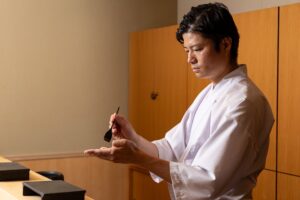
- Fan away the steamAn uchiwa (flat hand fan) lifts away surface moisture and brings up a soft gloss.
Fanning is often explained less as a way of cooling the rice than as a way of driving off excess moisture. Fan for too long and the rice slips below body warmth, so the work is done briskly.
Vinegar and temperature
The way we perceive vinegar shifts with temperature. In warm rice its aroma rises gently; as the rice cools, the acidity tends to linger more sharply on the tongue. Rice seasoned with akazu (red vinegar made from sake lees) carries a deeper colour and fuller aroma, and can feel heavy once it cools, which is why some chefs pay it especially close attention.
At Sushi Tanji, our rice is seasoned with a blend of red and rice vinegars, alongside two salts of differing character. As the balance of vinegar and salt changes, so too does the range of temperatures at which the rice tastes its best.
Keeping the warmth through service
Once seasoned, the rice is moved into an ohitsu, a lidded wooden container. Wood absorbs excess moisture while keeping the rice from drying out, and for that reason it remains a fixture at many counters today. Some long-established shops still nestle the ohitsu inside a woven straw basket to hold in its warmth.
Rice kept from the start of the evening to its close will slowly change in both temperature and texture. Many counters therefore cook fresh batches during service and season each one anew. It is also common to keep a smaller ohitsu close at hand, topped up little by little from a larger vessel.
The lid is closed again after every piece. The hands are moistened with tezu (vinegared water) before each portion of rice is taken. Small gestures like these are also part of the work of guarding warmth and moisture.
October and the new-season rice
October brings shinmai, the first rice of the new harvest. It is wonderfully fragrant, but it holds more moisture and its grains are softer, so it is said to take up vinegar less readily. Sushi chefs may use a little less water when cooking it, or blend it with rice from the previous year, to keep each grain distinct.
If, in early autumn, the rice seems a touch firmer or warmer than usual, you may be tasting the careful adjustments a chef makes as one year’s rice gives way to the next.
Enjoying the warmth at the counter
From the moment a piece is shaped, the rice begins slowly to cool. Enjoying it soon after it is set before you lets you taste it close to the temperature the chef intended. Many guests take a first bite mid-conversation and then pick up where they left off. There is no need to hurry, and nothing to worry about.
Fish passes from the fisherman to the market and on to the specialists who prepare it, and our aim is to serve it at the very moment it is at its best. At Tanji, the temperature of the rice is the final touch in that long chain of care.
Frequently asked questions
Is sushi rice usually served warm?
Yes. For Edo-style nigiri, a gentle warmth close to body temperature is the norm. When the rice in pre-made sushi feels cold, it is usually simply because time has passed and the temperature has fallen.
What temperature is body-warm sushi rice?
It is most often described as roughly body temperature. The precise figure varies from counter to counter: some keep track with a thermometer, while others rely on the feel of the chef’s hands.
Why is the rice fanned during seasoning?
It is usually explained less as a way of cooling the rice than as a way of driving off excess moisture and giving the grains their gloss. Fanning too long would take the rice below body warmth, so it is done briskly.
Should I eat each piece of nigiri straight away?
Because the rice cools as time passes, enjoying a piece soon after it arrives makes it easier to appreciate the contrast between warm rice and cool fish. There is no need to rush; your own pace is perfectly fine.
From the guide to the counter
Taste it at our eight-seat counter in Oku-Akasaka.
Classic Edomae craft with careful modern aging – served piece by piece, with English guidance for overseas guests.
Reserve at Sushi Tanji Explore The Tokyo Sushi Guide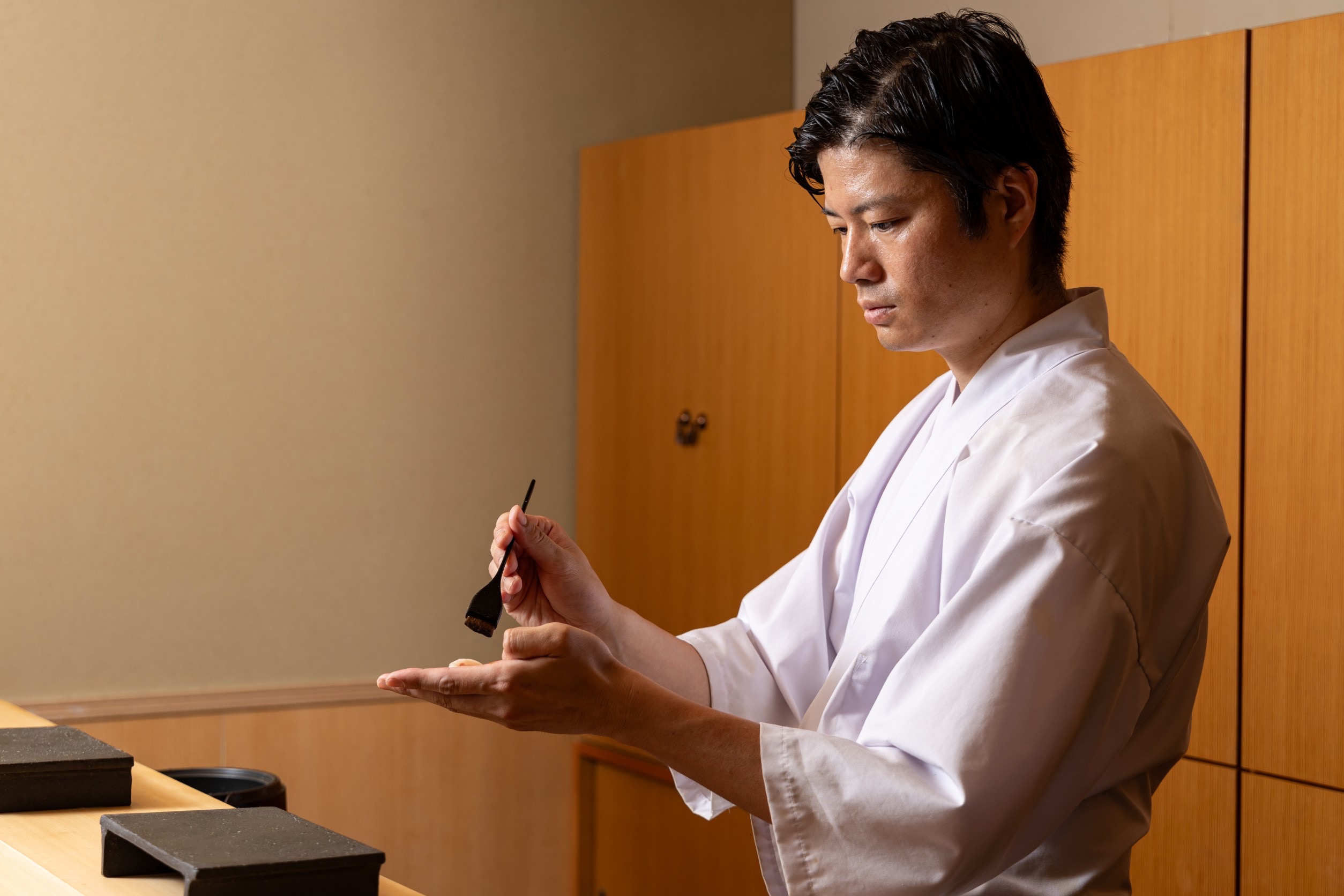
Reviewed by
Tatsuo TakadaHead chef and owner of Sushi Tanji. Trained in the Edomae tradition and rooted in Kyushu, he leads the eight-seat omakase counter in Oku-Akasaka, Tokyo, and reviews The Tokyo Sushi Guide.