Written by Oku-Akasaka Sushi Tanji, an omakase counter in Akasaka, Tokyo.See the menu →
Whether a question belongs at a sushi counter is settled less by the standing of the house than by timing. Since the work unfolds directly in front of you, brief exchanges were built into the design from the beginning. What follows sets out how to recognise an easy moment, what a question can sound like when said aloud, plus how to reshape the ones that are harder to answer.
In short
Questions are usually welcome at a sushi counter. The easiest opening is the breath just after you finish a piece. Ask briefly about the name of the fish, its home waters or the day’s preparation, then the conversation carries on without pausing the chef’s hands.
What you will learn
- How to recognise the moments when a question lands well, plus the ones to let pass
- Short phrasings you can say aloud exactly as they stand
- How to turn a hard question into an easy one
- How much conversation feels right, plus why silence never turns awkward
- Fish and preparations that make good August talk
Questions are usually welcome
An Edo-style counter sets chef and guest facing one another across a single plank of wood. Unlike a house where the kitchen sits behind a wall, the fish is cut, shaped into nigiri (hand-formed sushi), then placed in front of you. The design itself assumes a certain amount of quiet exchange. A question, in itself, rarely disturbs anything.
What deserves a little care is the shape of a question rather than its subject. One that tests knowledge or invites a long explanation can interrupt the rhythm of the nigiri. A short question about the piece just placed before you is the kind a chef answers most readily. When the fish is right there in hand, the words come while the work continues.
Easy moments and moments to let pass
The same question lands differently depending on when it is offered. A useful marker is the moment when your mouth is free at the same time as the chef’s hands.
- Just after you finish a pieceThe easiest breath of all. The chef is often between tasks here, hands briefly free.
- Moving from tsumami to nigiriTsumami (small dishes served before the sushi) give way to the hand-formed pieces at a natural seam in the meal. A word here flows straight into whatever comes next.
- Just before a piece is set downA moment to let pass. The shari (seasoned rice) shifts in temperature while an answer is given, so eating first keeps things pleasant on both sides.
- While several portions are being formed at onceWhen the hands are moving, watching is plenty. Waiting for a seam tends to bring a fuller answer anyway.
Questions you can use as they are
The shorter the question, the longer the reply tends to be. These can be said aloud exactly as they stand.
| What you want to know | A short way to ask | What tends to come back |
|---|---|---|
| The name of the fish | “What is this one called?” | Where it comes from, its season, the other names it goes by |
| The preparation | “How has this been prepared?” | Curing, marinating, the brushed nikiri glaze |
| How to eat it | “Is this fine as it is, without soy?” | When nikiri, salt or sudachi citrus each suit a piece |
| Drink pairing | “Is there a sake that suits this piece?” | How a brewery thinks about its work, how a serving temperature is chosen |
Each of these runs to a handful of words, yet each opens onto origins as well as craft. Remembering a name incorrectly costs nothing at all. Asking makes for a richer meal than staying quiet for fear of a correction.
Reshaping the harder questions
Some questions are simply harder to answer. The fault is rarely the question itself. A small change of shape is usually all it takes.
- Instead of “Which one is best?”“Which of tonight’s dishes is at its peak right now?” Asking about the season rather than ranking draws a concrete reply.
- Instead of “Where do you buy your fish?”“Roughly where is this one from?” Sourcing sits close to the heart of the business, so a question about waters travels further.
- Instead of “How many days was it aged?”“How long does this fish like to rest?” The number of days shifts with species as well as condition, so asking about the thinking opens the conversation.
Neither too much talk nor too little
Talking at the pace of an ordinary dinner lets the nigiri cool. An omakase (chef’s choice) meal has its own progression, with the chef watching how quickly guests eat. Conversation sits best when it rides that current.
Answers are sometimes brief. The closer a subject sits to the heart of the preparation, the fewer words it tends to draw. There is nothing to read into that. A short reply signals hands at work rather than a door closing.
At Sushi Tanji, for instance, bleeding and dressing the fish are treated as means rather than ends, with each fish given the ageing that suits it until it arrives at the moment it tastes best. Seen that way, you can imagine how much judgement is folded into a single sentence.
Worth asking about in August
August is a fine time to hear about shinko (the smallest juvenile gizzard shad) growing into kohada (gizzard shad). A difference of a few centimetres changes the name, along with how many fillets a single piece requires. That a fish should change its name as the season turns is easy to miss from the eating side alone.
Summer white-fleshed fish come up too, as do the ones just beginning to carry fat. Condition is hard to read by eye, so the quickest route is to ask about the piece in front of you. “What sort of preparation suits this time of year?” carries the point perfectly well.
If someone joining you speaks little Japanese, mentioning it when you book is reassuring. Some houses, Sushi Tanji among them, are glad to talk through the ingredients as well as the culture behind them in English. There is no need to brace yourself for any of it.
Frequently asked questions
Is it a nuisance to speak to the chef at a sushi counter?
Rarely. A short question about the fish in front of you, offered in the breath after you finish a piece, tends to be received as a natural part of the evening. What sits less easily is a long conversation begun just as a piece is being set down or while several portions are being formed at once.
What if the chef is a quiet one?
A brief answer does not mean the question was unwelcome. Subjects close to the heart of the preparation often draw the fewest words. When a short reply comes, return to eating, then offer another word at the next seam. That rhythm carries an evening along comfortably.
May I take photographs at the counter?
Policies differ from house to house, so a quiet word before the first piece arrives settles the matter. Where photographs are welcome, three habits keep things easy: framing so that other guests stay out of the picture, keeping sound as well as light discreet, then finishing quickly.
Can I come with someone who speaks only English?
Some houses offer guidance in English, so it helps to say so when you book. The shape of an explanation is the same in either language, whether the subject is the name of a fish or the work behind it. If you are unsure of being understood, keep the questions short by asking about one piece at a time.
From the guide to the counter
Taste it at our eight-seat counter in Oku-Akasaka.
Classic Edomae craft with careful modern aging – served piece by piece, with English guidance for overseas guests.
Reserve at Sushi Tanji Explore The Tokyo Sushi Guide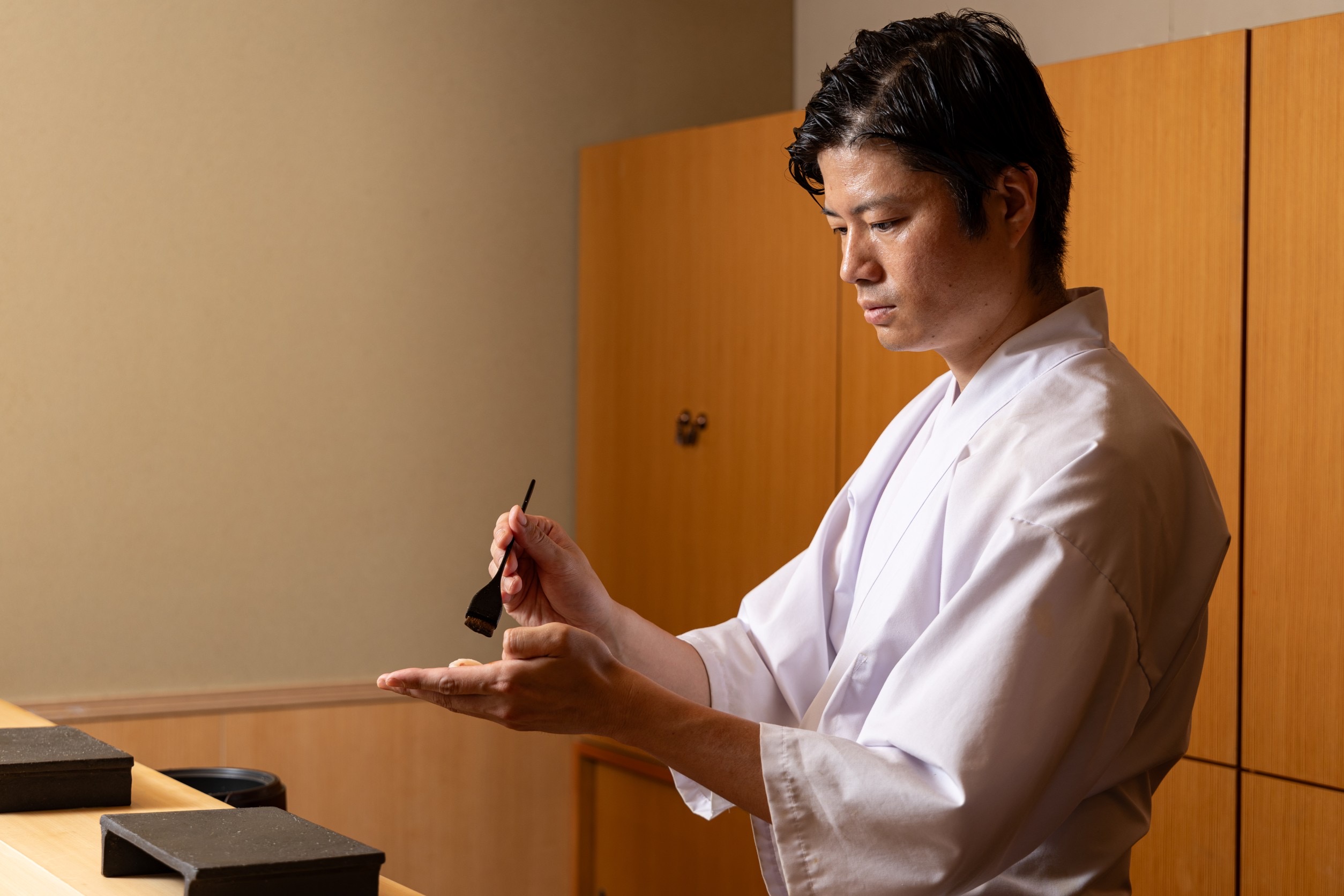
Reviewed by
Tatsuo TakadaHead chef and owner of Sushi Tanji. Trained in the Edomae tradition and rooted in Kyushu, he leads the eight-seat omakase counter in Oku-Akasaka, Tokyo, and reviews The Tokyo Sushi Guide.