A solo guest is the easiest reservation to place at a Tokyo omakase (the chef’s selection) counter. As a party grows to two or four, openings thin out, while a single place often lasts until the very end. What follows covers booking a seat on your own, finding a comfortable distance in conversation with the chef, along with what August brings to the counter.
In short
Eating sushi alone is welcome. The counter was built for guests arriving on their own, so in a room of around eight seats a single place is the one most likely to remain, which makes booking easier. Conversation can follow the chef’s hands, while eating in silence takes nothing away from the evening.
What you will learn
- Why a single seat is the last to fill, plus what that means for booking
- When a question lands well, along with why quiet is perfectly at home
- How the rhythm of nigiri runs straight to you when you sit alone
- Ordering sake in half measures or by the glass, changing with each piece
- August work at an Edomae counter: shinko, steamed abalone, anago
- What is worth mentioning at the time of booking
Why the counter welcomes a guest on their own
Edomae sushi began as street food. A piece was handed over the moment it was formed, two or three taken standing before the eater moved on. It was never a meal that waited for company. That shape survives intact at today’s omakase counters.
Nigiri is at its best in the seconds after it is shaped. Left to stand, the shari (seasoned rice) tightens as its warmth fades. A chef watches how quickly the guest in front of them finishes, then judges when to form the next piece. On your own, that rhythm travels in a straight line. There is no pause for a break in conversation, no waiting for a companion’s plate to empty.
One is the easiest booking to make
At a small counter of eight or so seats, pairs fill first, leaving one place open until the very end. On a day when an availability search shows nothing for two, switching to one can make a seat appear. Solo guests find booking easier less through special favour than through the simple arithmetic of how a counter fills.
Many Tokyo omakase rooms open around five in the evening with last seating near nine. Earlier slots go quickly to parties of two or more, so a single place is more likely to remain in the later round.
- Search for oneOn days that read as full for two, a single seat may still be open.
- Look at the later roundTimes close to last seating tend to hold on to a single place.
- Mention anything you would rather avoid when you bookOn the day itself the menu is difficult to rearrange; given notice in advance it can be set aside without fuss.
Conversation, at a comfortable distance
Many people brace themselves for an evening of continuous conversation. The opposite is nearer the truth: a solo guest eating quietly is an everyday sight at the counter. There is no need to steel yourself.
If you would like to speak, the moment just after a piece is set down, when the hands come to rest, carries well. While a knife is in the fish or rice is being formed, replies grow short. Nothing is being withheld; the work of the hands simply comes first. There is no need to hurry in with more words.
Questions that open onto the work last longer than those answered in a word. Rather than ‘what is this fish’, try ‘how long has it been aged’ or ‘which waters is it from’. At an Edomae counter, few chefs mind being asked about curing or the balance of a marinade.
When it arrives, eat it
This is where eating alone pays you back most. Nigiri is at its finest while the shari is still close to body temperature with the nikiri (a brushed soy glaze) still faintly damp. Anything wrapped in nori (dried seaweed) keeps its moment only as long as it still sounds under the tooth.
A piece left sitting while conversation runs on simply does not happen on your own. Guests who photograph tend to settle into a single frame, taken the moment the plate arrives.
Fingers or chopsticks, either is welcome. Neither troubles the side that serves.
Alone, sake is best taken a little at a time
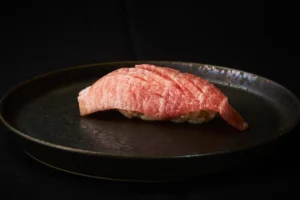
Ordered by the full measure, an evening reaches perhaps two varieties. On your own you might ask for half measures or by the glass, changing with each piece: something settled alongside red-fleshed fish, something more fragrant with white fish or shellfish. With no companion’s taste to accommodate, the choosing is entirely yours.
At Sushi Tanji in Oku-Akasaka, Tokyo, sake is chosen not as an accompaniment to sushi but as the element that completes a piece. The owner visits breweries across the country, selecting bottles with the maker’s thinking as well as the character of the place in mind. Rare labels appear among them.
An evening without alcohol is no trouble at all. Solo guests who stay with tea are a common sight at the counter.
The fish you meet at an August counter
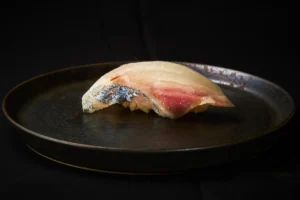
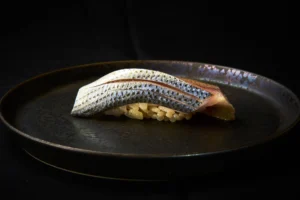
The pleasure of sitting alone in August is shinko, the young form of kohada (gizzard shad), each fish weighing only a few grams. Two or three are layered into a single piece, the work growing finer with every extra fillet. Salt with vinegar decides the flavour, so a chef’s hand shows plainly here.
Alongside it: steamed awabi (abalone), kisu (a delicate whiting) cured with kelp, kuruma ebi (tiger prawn), anago (saltwater eel) lifted straight from its simmering. Summer Edomae leans on fire, salt as well as vinegar, so more of the finishing happens in front of you. On your own you can watch those hands the whole way through.
The time after the meal
There is no need to rise quickly either. Once tamago (a sweet omelette) or a bowl of soup has closed the meal, tea gives you time to go back over the evening’s pieces. With no subject to find for a companion, the taste itself stays with you.
At Sushi Tanji in Oku-Akasaka, the meal ends in a proper tea room with matcha alongside a seasonal wagashi (Japanese sweet). Food, sake, vessels, the room itself, then that final bowl gather into one stretch of time. That is the thinking the house works by. On an evening spent alone, the quiet suits it well.
Frequently asked questions
Is it odd to eat at a sushi restaurant alone?
Not at all. Edomae sushi began as something eaten alone, a few pieces at a time, then off again. Today’s omakase counters treat a solo guest as an ordinary sight. In a room of eight seats, close to half the guests on a given evening may be dining on their own.
Is it harder to get a booking on my own?
More often the reverse. Pairs of adjacent seats fill first, so a single place tends to remain until the end. On a day when a search for two reads as full, switching to one can bring up a seat.
Am I expected to talk to the chef?
Not in the least. A solo guest eating quietly is entirely usual at the counter. When you do feel like speaking, the moment just after a piece is set down, when the hands come to rest, carries well; asking about ageing time or where a fish is from tends to open the conversation.
Does ordering omakase alone mean too much food?
Omakase is generally composed one portion at a time, so the amount per person changes little with the size of the party. If you are unsure about finishing, mentioning it when you book often allows an adjustment.
Can I walk in without a booking if I am on my own?
Rooms with few seats are usually reservation only, so it is safer to assume a walk-in will be difficult. Late openings do appear, though, which makes a look at same-day availability worthwhile.
From the guide to the counter
Taste it at our eight-seat counter in Oku-Akasaka.
Classic Edomae craft with careful modern aging – served piece by piece, with English guidance for overseas guests.
Reserve at Sushi Tanji Explore The Tokyo Sushi Guide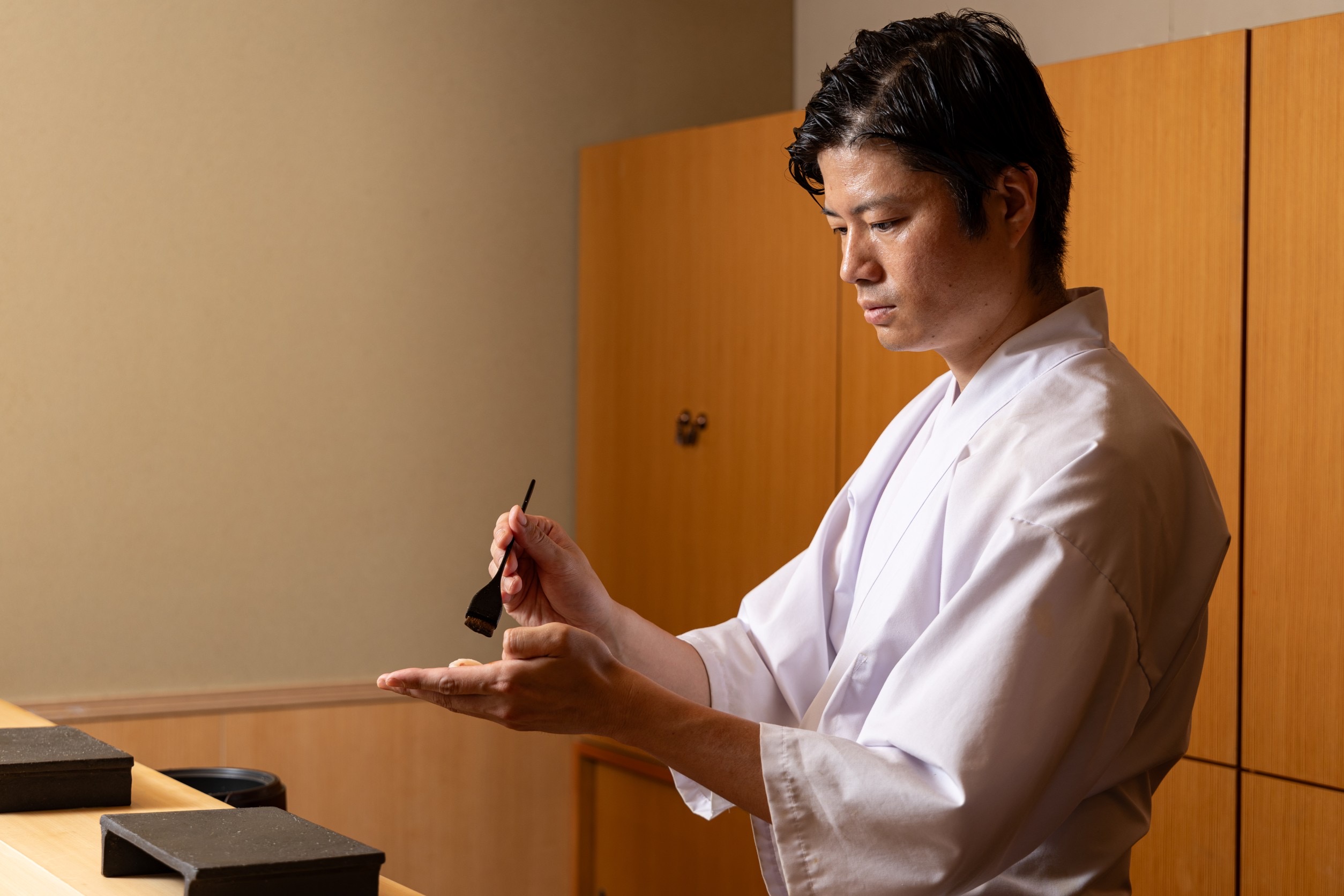
Reviewed by
Tatsuo TakadaHead chef and owner of Sushi Tanji. Trained in the Edomae tradition and rooted in Kyushu, he leads the eight-seat omakase counter in Oku-Akasaka, Tokyo, and reviews The Tokyo Sushi Guide.