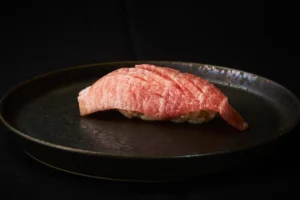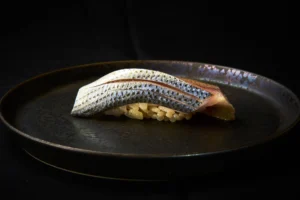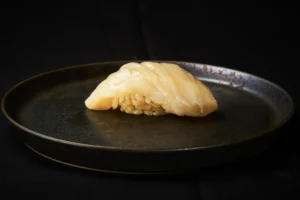


Written by Oku-Akasaka Sushi Tanji, an omakase counter in Akasaka, Tokyo.See the menu →
Squid and octopus sushi is shaped by three quiet pieces of work: kakushi-bōchō (hidden knife cuts), yushimo (a brief scald in hot water) and nidako (simmered octopus). Tuna and yellowtail win the palate with the sweetness of their fat. With squid and octopus, the smallest difference in knife or heat travels straight to the tongue. Here we look at what each technique is for, with a note on shin-ika, the young squid so often met at the counter in September.
In short
With no rich fat or strong aroma to lean on, squid and octopus reveal every detail of the hidden knife cuts, the timing of the scald and the way the octopus is simmered, in both texture and sweetness. That is why they are thought of as the pieces that show a chef’s skill most honestly.
What you will learn
- Why squid and octopus are seen as a showcase for a chef's skill
- How hidden knife cuts bring out a clean bite and sweetness
- The seasons and textures of shin-ika, sumi-ika, aori-ika, yari-ika and madako
- The few seconds of yushimo that set the skin while keeping the centre almost raw
- The Edo-mae steps for simmered octopus, from salt massage to sakura-ni
- Why the tenderness of simmered octopus differs from one counter to the next
Without fat to lean on, the work comes into view
Tuna and yellowtail fill the palate with the sweetness of their fat. Squid and octopus have almost none of that support. Their sweetness is delicate, so much of the impression rests on texture. That texture, in turn, changes a great deal with the knife and the heat.
With the same squid, a cut only fractionally deeper changes how readily it yields to the teeth. With simmered octopus, cooking time alone can give an entirely different spring. This is why, at an Edo-mae counter, squid and octopus are said to be where a chef’s skill truly shows.
Kakushi-bōchō: cutting the fibres to release sweetness
Squid flesh is densely fibrous. Pressed onto rice in a thick piece, it resists the bite and clings to the teeth. So the chef scores the surface with fine cuts. This is kakushi-bōchō, literally the ‘hidden knife’. The cuts are usually shallow enough to be almost invisible once the piece is formed. By severing the fibres they give a cleaner bite while letting the sweetness unfold on the tongue. They also give the nikiri (the soy-based glaze brushed over each piece) somewhere to settle.
Each chef has their own approach. Some score a fine crosshatch while others cut on the diagonal in one direction only. The thicker the flesh, as with aori-ika (bigfin reef squid), the deeper and finer the cuts tend to be. Some chefs leave the scoring on show as kanoko-bōchō, a dappled ‘fawn-spot’ pattern that doubles as decoration.
Squid and octopus through the seasons
In September, conversation at the counter often turns to shin-ika. These are the young of sumi-ika (golden cuttlefish, also known as kō-ika), appearing from late summer into early autumn. Early in the season they are tiny, yet many regulars look forward to them as one of Edo-mae sushi’s first tastes of the new season. The smallest may be served as maruzuke, a whole squid laid over a single piece of rice.
| Variety | Approximate season | Texture and typical preparation |
|---|---|---|
| Shin-ika (young sumi-ika) | Late summer to early autumn | Thin and tender. The smallest may be served whole as maruzuke |
| Sumi-ika (kō-ika, cuttlefish) | Autumn to winter | Thick with a clean bite. A long-standing Edo-mae favourite |
| Aori-ika (bigfin reef squid) | Spring to early summer or autumn, depending on region | Thick, silky and sweet. Rewards fine hidden cuts |
| Yari-ika (spear squid) | Winter to spring | Thin flesh with a light, clean sweetness |
| Madako (common octopus) | Said to be at its best in both summer and winter | Wonderfully versatile: raw, yushimo or simmered |
Yushimo: a few seconds that set the skin
Yushimo means passing only the surface through boiling water, then chilling it at once in iced water. The name, ‘hot-water frost’, comes from the way the surface turns white as though touched by frost.
Applied to the tentacles of a live octopus, yushimo tightens the skin and lifts its aroma while the inside keeps an almost raw translucence and sweetness. The difference lies in mere seconds. Too long and the heat reaches the core, turning it firm. Too short leaves the skin slippery with a lingering raw note. Squid tentacles (geso) are also hard to bite through raw, so they are sometimes briefly blanched then brushed with tsume, a sweet reduced glaze.
Nidako: the steps behind tenderness
In Edo-mae sushi, octopus has long meant nidako, simmered octopus. Octopus toughens easily, so over the years chefs have layered one technique upon another to cook it tender.
- Salt massageSalt is worked into the octopus to lift away its slippery coating along with any grit.
- TappingA time-honoured method is to tap the flesh with a daikon radish or similar to loosen the fibres.
- BlanchingA quick dip in hot water before simmering settles the colour and shape of the skin.
- SimmeringThe octopus is simmered in a broth of sake and soy sauce, sometimes with bancha tea or azuki beans. Cooked with azuki, it is called sakura-ni for its soft cherry-blossom blush.
- Resting in the brothOnce off the heat, it cools in the broth so the flavour reaches right to the centre.
Ideas of tenderness differ from counter to counter. Some lift the octopus out early to keep its spring. Others simmer it long over a low flame until it almost melts under the teeth. Octopus is said to tighten partway through cooking before softening again as it continues. Where the chef chooses to stop reveals their taste and their thinking.
What to notice at the counter
When squid or octopus arrives, let your attention settle first on texture. The fineness of the hidden cuts, the taut skin of a yushimo piece, the way simmered octopus gives way. None of it is spoken aloud, yet all of it lives within a single piece. If you are curious, you might ask, “How long do you simmer this octopus?” There is no need to feel shy. Most chefs are glad to talk about their work.
Some hold that squid grows sweeter after a short rest, so the moment it is served varies from chef to chef. At Sushi Tanji, preparation is a means rather than an end. Each fish is aged in the way that suits it, then served at the moment it tastes best. Squid and octopus, whose flavour shifts with every touch of the hand, offer a lovely way to taste that thinking for yourself.
Frequently asked questions
When is shin-ika in season?
Shin-ika are the young of sumi-ika (golden cuttlefish) and usually appear from late summer into early autumn. Early in the season they are small with thin, tender flesh. As autumn deepens they grow, gradually becoming the thicker sumi-ika.
What are the fine cuts on a piece of squid nigiri?
These are kakushi-bōchō or hidden knife cuts. They sever the dense fibres so the squid is easier to bite through while its sweetness unfolds on the tongue. They also help the nikiri glaze settle into the surface.
Why does simmered octopus vary in tenderness from one restaurant to another?
Each counter has its own view on cooking time and heat. Some lift the octopus early to keep its spring while others simmer it slowly until soft. Preparation such as salt massage and tapping also plays its part in the final tenderness.
How does yushimo octopus differ from nidako?
Yushimo passes only the surface through hot water for a few seconds, leaving the inside with a near-raw sweetness and translucence. Nidako is simmered through to the centre so it absorbs the flavour of the broth. From the same octopus come two entirely different textures and aromas.
From the guide to the counter
Taste it at our eight-seat counter in Oku-Akasaka.
Classic Edomae craft with careful modern aging – served piece by piece, with English guidance for overseas guests.
Reserve at Sushi Tanji Explore The Tokyo Sushi Guide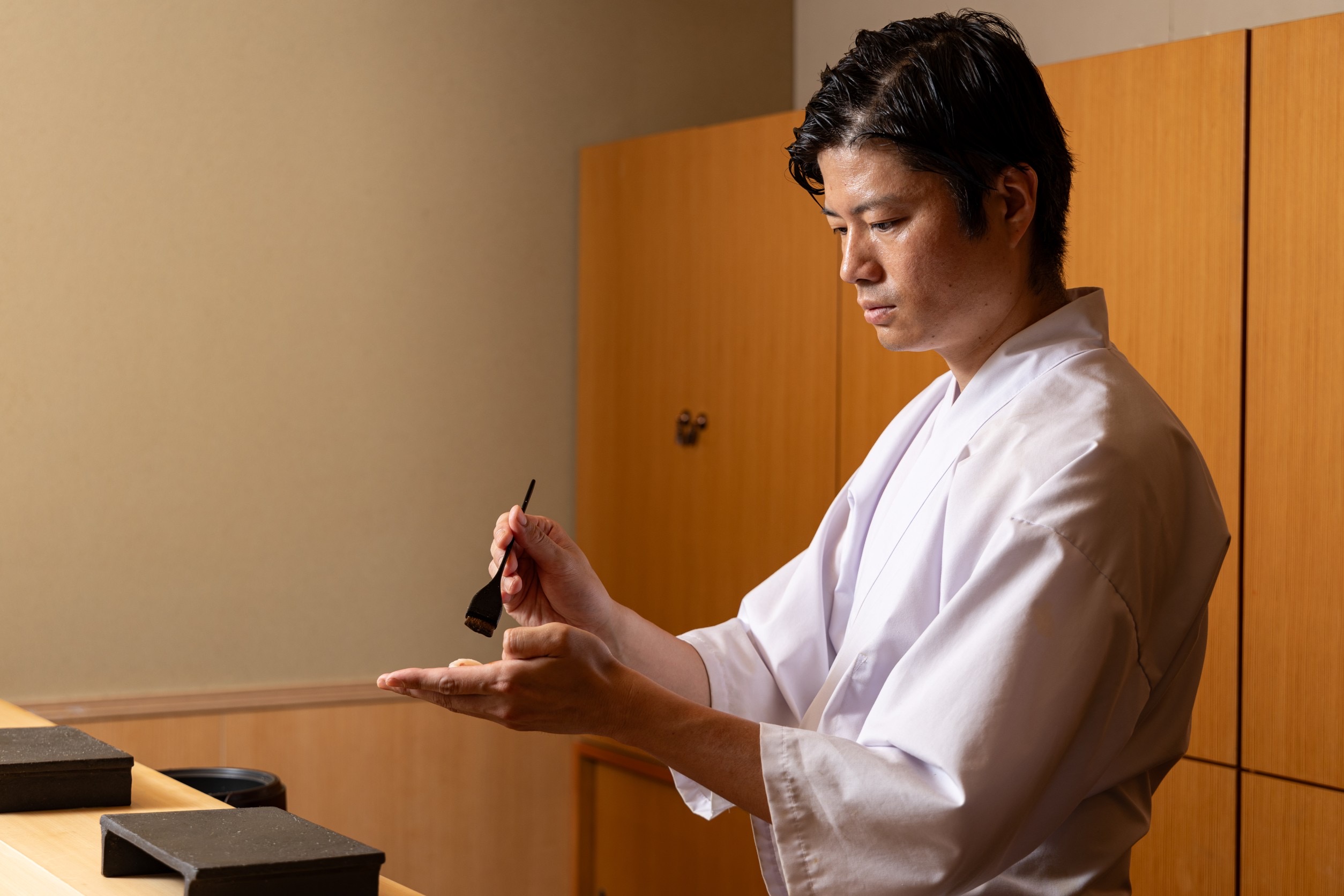
Reviewed by
Tatsuo TakadaHead chef and owner of Sushi Tanji. Trained in the Edomae tradition and rooted in Kyushu, he leads the eight-seat omakase counter in Oku-Akasaka, Tokyo, and reviews The Tokyo Sushi Guide.