


Written by Oku-Akasaka Sushi Tanji, an omakase counter in Akasaka, Tokyo.See the menu →
At Tokyo’s omakase counters, bookings tend to fill from one to two months ahead. A fully booked notice is not the end of the story, though. Cancellations cluster at predictable moments, while certain slots reliably open up at the last minute. This article looks at when to act, what a waitlist really delivers, which times free up most readily, plus the order in which to line up alternatives if your first choice is full, all with an eye on September at the counter.
In short
Most Tokyo omakase sushi counters open bookings one to two months ahead, with many releasing the next month’s seats at the start of the month. Even when a counter shows full, joining the waitlist and watching for weekday early sittings or openings from the day before onwards gives you a real chance of a seat.
What you will learn
- When bookings open depends almost entirely on the counter's style: online platform, telephone only or introduction-based
- Cancellations tend to cluster just before the cancellation fee applies, typically two to four days out as well as the day before
- The seats most likely to open late are weekday early sittings, the later seating at two-sitting counters, plus single seats
- Fix the date first, then narrow to three candidate counters, so availability can be checked almost mechanically
- Hold only one booking at a time; if plans change, letting the counter know early is what frees a seat for someone else
- In September, typhoon weeks bring more day-before openings, while many counters release December seats during autumn
How far ahead? Three kinds of counter, three timelines
Bookings at Tokyo’s omakase counters fall into three broad types: counters that take reservations through an online platform, those that accept telephone only, plus those that give priority to introductions or regulars. How far ahead you can book is largely settled by which of these you are dealing with.
Counters on an online platform often release the following month, sometimes two months ahead, all at once at the start of the month. The typical pattern is that weekend slots go on release day itself, while weekday early sittings linger for a few days. Telephone-only counters usually answer in the early afternoon, once the morning’s preparation is done. If the call connects a month to a few weeks ahead, there is a fair chance of a seat. Introduction-based counters are, frankly, difficult for a first-time guest to book unaided.
| Counter style | When bookings open | A realistic approach |
|---|---|---|
| Online reservation platform | Next month released at the start of the month, sometimes two months ahead | Secure a weekday early sitting on release day. If it is gone, join the waitlist |
| Telephone only | A month to a few weeks ahead | Call in the early afternoon, outside service hours. Give your party size plus a range of times |
| Introduction-based or regulars first | New seats rarely appear | Build outwards from a counter where you have already sat, through personal connections |
Sushi Tanji in Oku-Akasaka, for instance, has eight seats at a hinoki (Japanese cypress) counter, with bookings taken through TableCheck. Doors open at 5pm with last entry at 9pm, so availability differs between the early and late seatings, something it shares with most small counters.
The waitlist, realistically: openings cluster a few days out
A waitlist is a more practical tool than it might seem. The reason lies in when cancellations happen. Most counters apply a cancellation fee from three days out or from the day before, so guests whose plans have changed tend to call just before that line is crossed. Openings therefore concentrate two to four days ahead of the visit, plus the day before.
Register on the platform’s waitlist and a notification arrives the moment a seat frees up. Others are waiting too, so there is little time to deliberate once it lands. Decide the date and party size in advance so that you can confirm on the spot; this alone raises your chances markedly.
With a telephone counter, simply asking to be called if anything opens up is worthwhile. Add your party size plus the range of times you can accept (a single seat is fine, 5pm is fine, that sort of thing), which makes it easier for the counter to reach out. There is no guarantee the call will come, but the broader your flexibility, the more likely it is.
Which sittings tend to open at the last minute
The seats most likely to appear late are weekday early sittings. A 5pm or 5:30pm start is hard to reach straight from work, so these linger on release day. They are also the first to return after a cancellation. Next come the later seatings at counters with two sittings. An 8pm or 8:30pm start is often given up by guests thinking about the next morning.
Monday to Wednesday sees more day-before openings than the rest of the week, as do rainy days or weeks when a typhoon is forecast. September is exactly that season, with unsettled weather setting seats in motion. A quick look at the platform in the early afternoon the day before, then again around 3pm on the day, is the shortest path to an unexpected seat.
Plan as if you won't get in: narrowing to three counters
Assuming from the outset that the first choice may be full makes the whole exercise calmer. The order runs: fix the date, pick three counters you could visit that day, then be clear about which conditions you are willing to relax.
- Fix the date and party sizeStarting from a list of counters, the options spread without end. Fix the date first and availability can be checked almost mechanically.
- Narrow to three countersA workable mix is a first choice, a second that is similar in style but easier to book, then a third where an early sitting would suit you perfectly well.
- Keep early sittings and single seats on the tableThe 5pm slot and the single seat are where availability tends to linger. Whether you can relax on these changes your odds considerably.
- Run the waitlist alongside last-minute checksJoin the waitlist for your first choice, but hold only one confirmed booking. That spares both the counter and whoever is waiting behind you.
The questions that surface before a first counter visit can wait until the booking is in hand. Dress, arrival time and how to order are covered elsewhere in our Tokyo Sushi Guide, so there is time once the seat is settled.
Waiting well: the courtesy that opens the next seat
At a small counter, one empty seat is one party’s whole evening. At an eight-seat counter, a single no-show means fish prepared for that party has nowhere to go. If plans change, a call the moment you know is enough. That alone sends the seat to someone who is waiting.
Holding several counters for the same night and choosing on the day is visible from the counter’s side too. Reservation platforms keep a record of visits, so a run of last-minute cancellations can make a counter hesitant to accept the next booking. Keeping to a single hold protects your own seat in the end.
Conversely, many guests who have finally sat at a counter ask about the next visit on their way out. Some counters will take a future booking there and then, a reliable shortcut that makes every visit after the first far easier. At a place like Tanji, where sushi, sake, ceramics, the room, conversation and a final cup of tea are layered towards an evening you want to return to, it is not unusual for that conversation to arise at the door.
Booking in September: autumn fish and moving seats
September counters begin to show modori-gatsuo (the fattier autumn run of bonito), sanma (Pacific saury) plus the season’s first ikura (salmon roe). It is also when bookings, quiet at the end of summer, start to move again, with weekend slots filling first around the public holidays and the end of the month. Weekday early sittings remain relatively available even now.
In a week when a typhoon is forecast, by contrast, day-before openings multiply, even at counters that are usually hard to book. Watch the forecast, then aim for a weekday early sitting on a day you can manage. September is a month when that works quite straightforwardly.
If you have your eye on December, many counters release those seats between October and November. Confirming your first choice’s release day this autumn saves any rush later. Knowing the release day is a surer move than any waitlist.
Frequently asked questions
How far in advance can I book a sushi counter?
Counters on an online platform commonly release the following month, sometimes two months ahead, at the start of the month. Telephone-only counters work on a month to a few weeks ahead. Introduction-based counters rarely have new seats, so building outwards from a counter where you have already sat is the more realistic route.
How soon does a waitlist actually come through?
There is no guarantee, but openings tend to cluster two to four days before the visit plus the day before, because most guests cancel just before the cancellation fee applies. Settle the date and party size in advance so you can confirm without hesitation when the notification arrives.
Is there a way to find a sushi counter with a seat today?
The shortest route is checking reservation platforms in the early afternoon the day before, then again around 3pm on the day. Weekday early sittings, the later seating at two-sitting counters and single seats tend to remain, while rain or a typhoon brings more openings. At a telephone counter, an early-afternoon call may turn up that day’s availability.
Can I book a sushi counter for one?
Yes. A single seat at the end of the counter is often the last to go, so a party of one is generally easier to place than two or more. Mentioning that a single seat is fine when you join a waitlist or call broadens the chances of being contacted.
Which is easier, an online platform or the telephone?
That depends on the counter. Platform counters fill all at once on release day, so knowing that date is the key. Telephone counters are easiest to reach in the early afternoon, once the morning’s preparation is done. Giving your party size with a range of times can then turn up a seat.
From the guide to the counter
Taste it at our eight-seat counter in Oku-Akasaka.
Classic Edomae craft with careful modern aging – served piece by piece, with English guidance for overseas guests.
Reserve at Sushi Tanji Explore The Tokyo Sushi Guide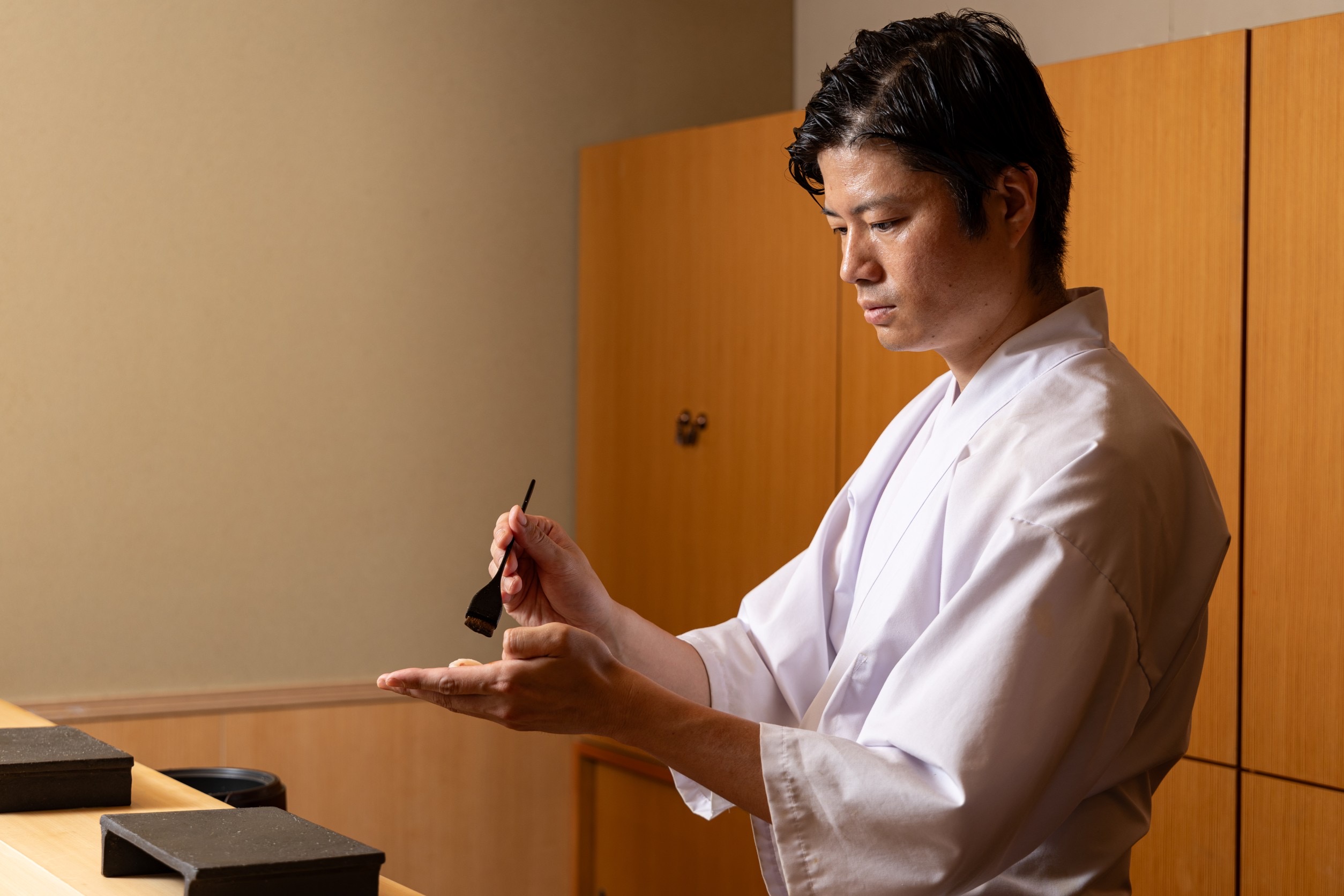
Reviewed by
Tatsuo TakadaHead chef and owner of Sushi Tanji. Trained in the Edomae tradition and rooted in Kyushu, he leads the eight-seat omakase counter in Oku-Akasaka, Tokyo, and reviews The Tokyo Sushi Guide.