Written by Oku-Akasaka Sushi Tanji, an omakase counter in Akasaka, Tokyo.See the menu →
Search for sushi in Akasaka and you will find counters of quite different character within a few minutes’ walk: an eight-seat omakase (the chef’s choice), a room of a dozen or more seats, a place with private rooms suited to entertaining. All of them are Akasaka sushi. Yet seat count and start time shape the whole evening. This piece traces how the district moved from teahouse quarter to business quarter, then sets out how to recognise the counter that suits your purpose.
In short
Akasaka’s sushi carries the legacy of its ryōtei years, so restaurants with private rooms for entertaining are common. A small counter of around eight seats moves at a different rhythm from a room of a dozen or more. Seat count, start time plus the way bookings are taken are the quickest three things to read.
What you will learn
- How Akasaka became a district for entertaining, plus what that left behind in its sushi restaurants
- How seat count shapes the rhythm of a counter and the occasions it suits
- A way of thinking about hosting at a counter as against sitting alone
- How the crowd changes between the five o'clock sitting and the eight o'clock one
- Four points to weigh when choosing a restaurant in Akasaka
- The fish that appear in September in the Edomae tradition, plus the work they receive
What sets Akasaka sushi apart from other districts
What sets Akasaka apart is not the number of sushi restaurants but the range of reasons people come. In the stretch between Akasaka-mitsuke and Tameike-sannō you will find, all within walking distance, places for a light lunch of nigiri (hand-formed sushi) as well as eight-seat counters that open only in the evening. On weekday nights the seats fill early with people finishing work or hosting guests. At weekends the pavements quieten, so a seat may still be free on the day itself. The same district looks quite different depending on the day of the week and the hour.
From teahouse quarter to business quarter: what the district left behind
Akasaka began as a district of ryōtei (traditional restaurants with private rooms). A geisha quarter spread below the slope of Hie Shrine, then, with ministries plus broadcasters close by, the postwar years gave the area its character as a place for entertaining. Most of the ryōtei have gone. Their manners stayed on in the sushi restaurants: an entrance set one street back from the main road, a sign kept modest, a private room or a raised tatami alcove held in reserve, a late party still welcomed. The stillness of an Akasaka counter reads as a continuation of the district’s memory.
How seat count decides the character of a counter
The character of a counter follows largely from its seat count. With fewer seats, one chef can keep an eye on everyone, so the pace of forming sushi tends to match the pace of eating. As seats increase, service staff step in, then conversation divides seat by seat. Neither is better. It is a question of what suits the evening.
| Seats | How the meal moves | Best suited to |
|---|---|---|
| 6 to 8 | Everyone tends to begin at the same hour, so talk of the fish reaches the whole counter | Dining alone or as a pair |
| Around 10 | Guests may arrive at staggered times, so conversation settles into pairs | Small gatherings |
| A dozen or more, with private rooms | Some distance opens between the kitchen and the seats, with service staff bridging it | Entertaining; groups whose number is hard to predict |
Hosting at the counter and sitting there alone
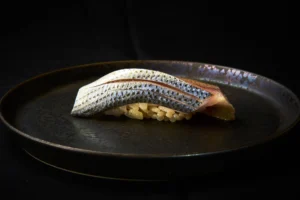
If you are hosting at a counter, deciding in advance where the guest of honour will sit saves any fuss on the night. The seat facing the itaba (the chef’s working area) gives the best view of the work, though it also invites more exchange with the chef, so on an evening when business is the point, a seat towards the end can feel calmer. Sitting alone, the opposite holds: the centre is the most interesting place to be. In September you can watch, from close range, how the curing is judged as shinko (young gizzard shad) grow into kohada (gizzard shad).
Start times and the rhythm of booking
In Akasaka the crowd shifts between the sitting that begins around five in the evening and the one that begins near eight. The earlier sitting draws parties dining together as well as guests from out of town; the later one tends towards solo diners plus couples who have finished work. For a quiet evening, the later sitting often turns out to be the calmer choice. In Oku-Akasaka, Sushi Tanji opens at five, with last entry at nine. Its eight-seat hinoki cypress counter keeps room for one late party. When booking, the number of guests, the occasion plus anything you would rather avoid are all that need saying.
Four points to weigh when choosing in Akasaka
In a district this full of information, deciding the order in which you look at things keeps you from wavering. Working down the four points below narrows the field considerably.
- Seat countAround eight puts you close to the chef; a dozen or more leaves conversation free to wander.
- Start timeWhether everyone begins together or arrival can be staggered. Choose by how your working day ends.
- Who is with youAlone, hosting, an old friend after some years. This is where private rooms start to matter.
- The approach to sakeLess the number of labels than whether there is a thought behind pairing each piece. At Tanji, sake is treated as something that completes the sushi, with the owner selecting labels after visiting breweries around the country.
The work you meet in Akasaka in September
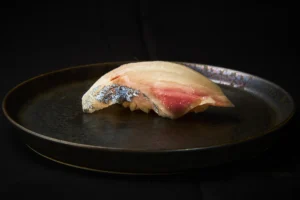
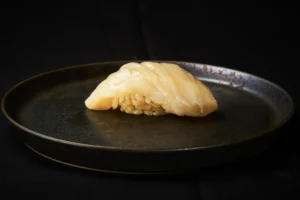
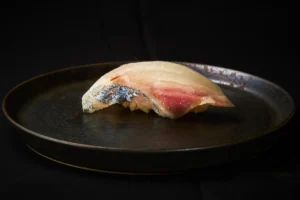
September in the Edomae tradition (the sushi of old Tokyo Bay) sits on the way from summer into autumn. The shinko of high summer have grown into kohada, so curing times shift a little week by week. Shin-ika, the season’s young squid, is still tender; how the knife enters it changes the way it meets the mouth. Bonito turns towards its returning run, its fat altering by the day. The Edomae methods of curing, marinating in soy plus brushing with nikiri (a sweetened soy glaze) were built up to meet exactly these changes in the fish. Bleeding the fish at the dock or ageing it work the same way: not ends in themselves, only means of bringing a fish nearer the moment it tastes best.
Frequently asked questions
Is it easy to eat alone at a sushi counter in Akasaka?
Smaller omakase counters generally expect solo guests, so letting the restaurant know you will be one person when you book is all it takes for a seat to be set aside. There is no need to feel you are imposing. The later sitting tends to have the higher share of people dining on their own.
Does Akasaka suit business entertaining?
As a legacy of the ryōtei years, the district has a relatively high number of restaurants with private rooms or raised tatami alcoves. For a gathering whose numbers are still uncertain, as well as for a meal that carries some business, a place with a private room can be easier to work with than a counter alone.
How far ahead should a sushi restaurant in Akasaka be booked?
The fewer the seats, the sooner they fill, so looking a few weeks ahead is comfortable even midweek. Cancellations do open up, though, so a call the day before or on the day itself sometimes finds a place. Some restaurants are easier to book at weekends than midweek.
How does sushi in Akasaka differ from Ginza?
The work itself follows no district rulebook. The difference shows in why people come. Akasaka fills with guests stopping in after work or dining together on business, while small restaurants sit tucked along its side streets. On a first visit the signs can be hard to spot, though noting down the full street address makes the walk straightforward.
From the guide to the counter
Taste it at our eight-seat counter in Oku-Akasaka.
Classic Edomae craft with careful modern aging – served piece by piece, with English guidance for overseas guests.
Reserve at Sushi Tanji Explore The Tokyo Sushi Guide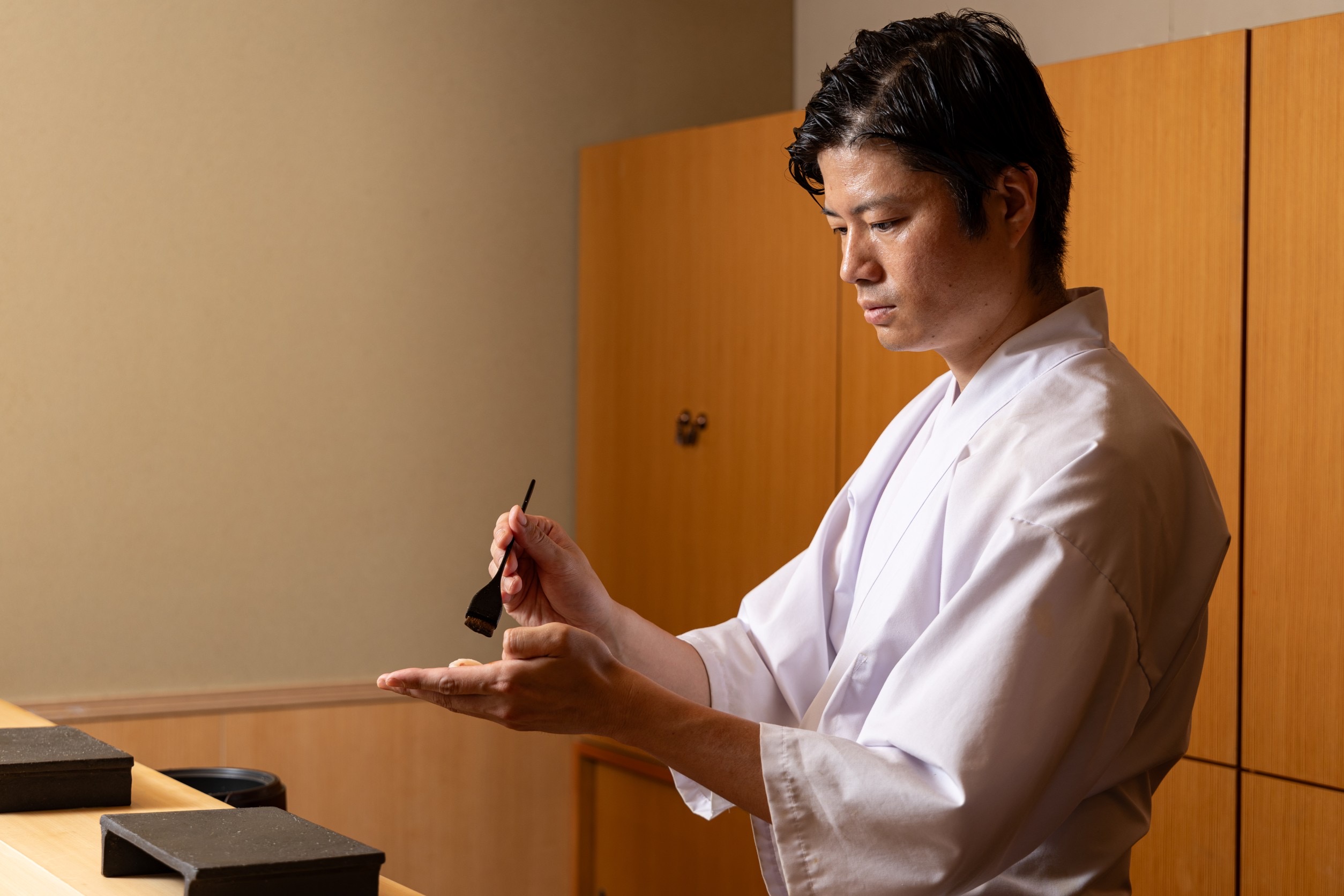
Reviewed by
Tatsuo TakadaHead chef and owner of Sushi Tanji. Trained in the Edomae tradition and rooted in Kyushu, he leads the eight-seat omakase counter in Oku-Akasaka, Tokyo, and reviews The Tokyo Sushi Guide.