At the Toyosu auctions, the person bidding for a fish is usually not a sushi chef but an intermediate wholesaler, known in Japanese as a nakaoroshi. Between the sea and a Tokyo sushi counter, a single fish passes through many pairs of hands: the fishermen, the buyers at the landing port, the primary wholesalers who receive the catch, then the intermediate wholesalers who select for each restaurant. This piece follows that path. How the buildings at Toyosu divide the work, the difference between seri (auction) with aitai (negotiated sale), the eye of the intermediate wholesaler, plus the handling at the source that tells most in the heat of August. Less a visitor’s guide than an account of how fish travels.
In short
At Toyosu, primary wholesalers gather consignments from across the country then sell them by auction as well as by negotiated sale. The intermediate wholesalers who buy there pass the fish on to sushi restaurants. It is uncommon for a restaurant to bid at auction itself. The fish is chosen by a wholesaler who knows how that counter tastes.
What you will learn
- Where the work divides between primary wholesalers and intermediate wholesalers
- When fish moves by auction, when it moves by negotiation, plus which carries the greater volume
- What the cut face of a tuna's tail reveals, along with how wholesalers specialise
- Bleeding at the source with chilling to the core, the work that carries August fish
- Buying ahead of market closing days, with ageing to bridge the gap
- What buying at the market offers, plus what comes with direct shipping
Toyosu: The Place Where Fish Changes Hands
Toyosu is one of Tokyo’s central wholesale markets, opened in 2018 when the trade moved from Tsukiji. The seafood side occupies two buildings: one for the primary wholesalers, one for the intermediate wholesalers. The division of the buildings is the division of the work.
Primary wholesalers take in fish consigned from producing regions across Japan, set a price then sell it on. Intermediate wholesalers buy that fish, dividing it among sushi restaurants, other kitchens, plus retail shops. Several hundred intermediate wholesalers trade at Toyosu, each shop specialising by species. The halls were built as an enclosed environment, sealed from outside air with rain kept out, so that a fish never loses its cold.
The Road a Fish Travels, from Sea to Nigiri
A single fish usually passes through four or five sets of hands before it reaches a Tokyo sushi counter. At every stage two jobs run in parallel: judging the fish, keeping it cold.
- Fishermen and the fishery co-operativeFish landed at the port are sorted here. Ikejime, the swift dispatch of a fish, plus bleeding usually happen at this stage.
- The market at the landing portThe catch goes to auction once near the water, where regional buyers make their purchases. There is an auction before the Tokyo auction.
- TransportPacked in polystyrene boxes with ice, the fish travel to Tokyo by road or by air. Much of the consignment reaches Toyosu overnight.
- Primary wholesalersThey receive the consignments, lay them out by species, then set prices by auction or by negotiation.
- Intermediate wholesalersThey sort what they have bought to suit each restaurant’s taste, wrapping it for collection.
- The sushi restaurantPreparation runs through the day, with curing, marinating, plus ageing timed to meet the evening service.
Auction or Negotiation: How the Fish Moves
There are two ways a price is settled. One is seri, the auction, called up by voice with hand signals. The other is aitai, a negotiated sale agreed between the primary wholesaler and the buyer.
| Aspect | Auction (seri) | Negotiated sale (aitai) |
|---|---|---|
| How the price is set | Buyers bid upward; the highest takes the fish | Settled in conversation between wholesaler and buyer |
| Fish it tends to cover | Scarce, high-value fish such as wild bluefin tuna | Fish landed daily, farmed fish, shellfish |
| Timing | A short window in the early morning | From the previous evening through to that morning |
By volume, negotiated sales account for the larger share. The early-morning tuna auction is the market’s public face, yet most of the fish that moves through Toyosu is priced in quiet conversation. Those who may buy are the intermediate wholesalers plus licensed trade participants. A few sushi restaurants hold that licence and join the auction; buying from an intermediate wholesaler is the more usual course.
The Wholesaler's Eye Is a Specialist's Eye
Intermediate wholesalers divide finely by what they handle. Shops for tuna alone, shops for white-fleshed fish with live fish, shops for hikarimono (the silver-skinned fish) such as kohada (gizzard shad) with aji (horse mackerel), shops for shellfish, shops for anago (conger eel) with freshwater fish. A single sushi restaurant drawing on several wholesalers is an everyday arrangement.
With tuna, the cut face of the tail is read: the sheen of the flesh, the way the fat is marbled, the run of the sinew. Even within one fish the back reads differently from the belly, so the judgement extends to which section goes to which restaurant. For hikarimono, the fat of the season with the firmness of the flesh is confirmed by hand. This reading is not only a matter of choosing fish.
Carrying August Fish While Still Cold
August brings warm water, so fish tire quickly. In this season the handling at the source shows up directly in the flavour. The fish is dispatched, bled at once, then chilled with ice to the core. A fish stinted on here cannot be recovered however fast it travels.
The August counter holds shinko (the year’s first young gizzard shad), anago, tachiuo (scabbard fish), awabi (abalone). Shinko are tiny, several laid over one another for a single piece, so the preparation takes time.
The market keeps closing days, most often Wednesdays with Sundays plus public holidays. Buying a little more ahead of a closure then bridging the gap through ageing sits comfortably with Edomae preparation. At Sushi Tanji too, ageing judged for the right period and temperature by species is set alongside the Edomae work of curing plus marinating. The order of things is to decide how long each fish should rest rather than to sell it off in a hurry.
Two Ways In: The Market plus the Direct Shipment
In recent years more fish arrives sent straight from the fishermen or from the dressers who prepare it at the source. Skipping the market makes the time since dispatch easier to read. Then again, some fish can only be met where consignments from the whole country gather at once. Neither route is the better one; most restaurants in Tokyo today draw on both.
Sushi is the work of forming fish into nigiri; it is also the work of carrying a life forward. The fisherman lands the fish, the intermediate wholesaler reads it, the dresser tends to it, then the sushi chef receives it last. Tanji approaches each fish in that spirit, choosing what is in season from across Japan with a leaning towards Kyushu, where the chef was raised.
Ask the name of a fish at the counter and you may hear about where it was landed with how it was dispatched. That is not a boast; it is a record of the road one piece has travelled. No difficult knowledge is needed. A name with a place is enough to change how the fish looks to you.
Frequently asked questions
Can anyone visit Toyosu Market?
Certain areas are open. There is a viewing deck above the tuna auction, viewing from the corridors, plus zones for dining with shopping. The intermediate wholesalers’ hall is a working floor for buyers, so access is limited by time as well as by route, with some tours asking to be booked in advance. Checking the conditions on the Tokyo Metropolitan Government’s guidance before you go makes for an easy visit.
Do sushi restaurants bid at the auctions themselves?
Most buy from intermediate wholesalers. Joining an auction calls for a licence as a registered trade participant; a small number of restaurants hold one. Some chefs go to the market each morning to choose with their own eyes; others telephone a wholesaler they have worked with for years. Neither is more authentic than the other.
Did the fish change when the market moved from Tsukiji to Toyosu?
The way fish changes hands has stayed much the same. Primary wholesalers sell by auction as well as by negotiation, then intermediate wholesalers make the selection, exactly as at Tsukiji. What changed is the building: enclosed now, which makes temperature as well as hygiene easier to hold. For summer fish, that difference tells.
Is fish shipped direct from the source fresher?
Freshness is not measured in days alone. How a fish was dispatched, how it was chilled, then how long it was allowed to rest for its kind all shape the flavour. A fish handled with care at the source arrives in fine condition even by way of the market, while a direct shipment handled roughly will fall away. Looking at what hands have touched it is quicker than looking at the date.
From the guide to the counter
Taste it at our eight-seat counter in Oku-Akasaka.
Classic Edomae craft with careful modern aging – served piece by piece, with English guidance for overseas guests.
Reserve at Sushi Tanji Explore The Tokyo Sushi Guide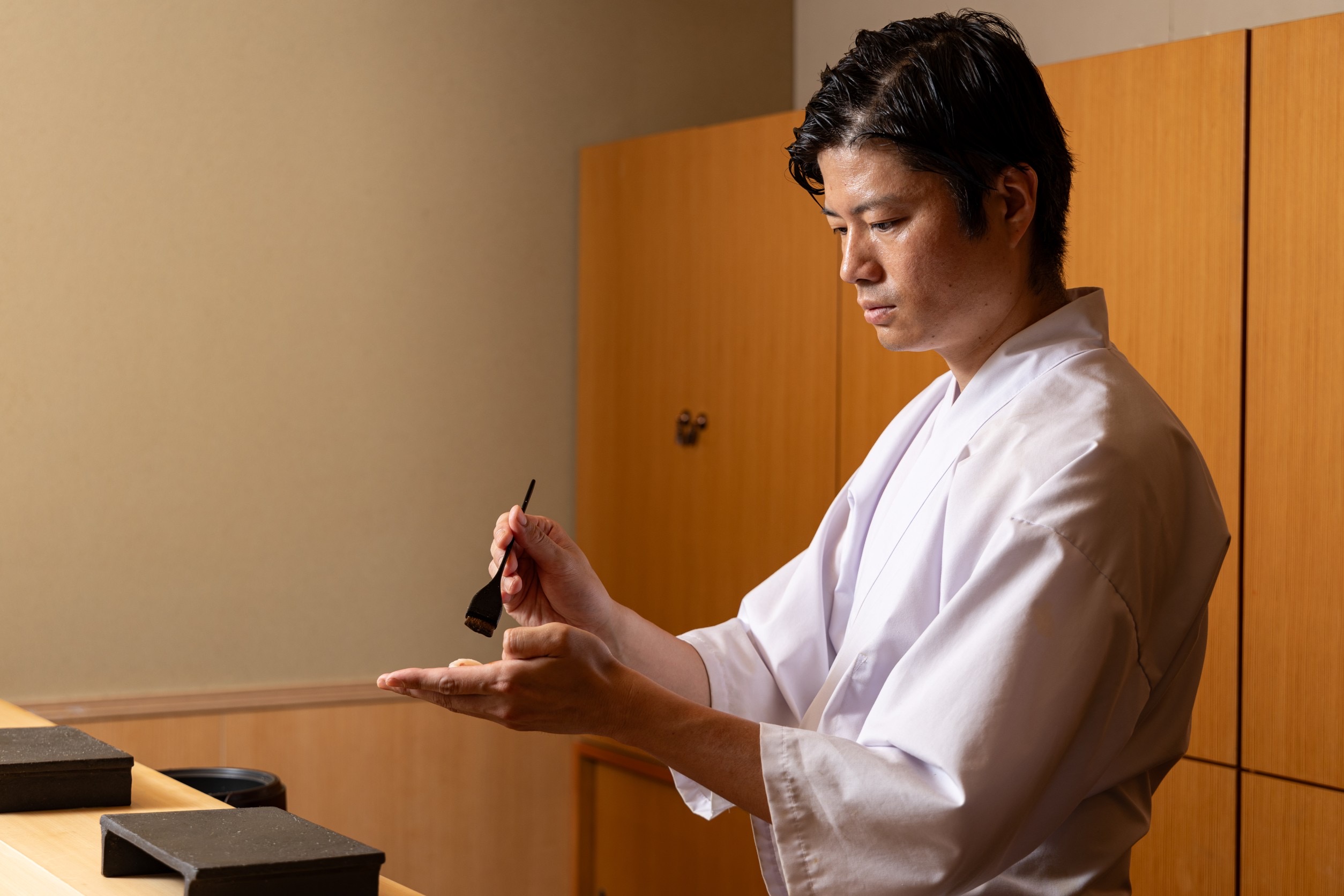
Reviewed by
Tatsuo TakadaHead chef and owner of Sushi Tanji. Trained in the Edomae tradition and rooted in Kyushu, he leads the eight-seat omakase counter in Oku-Akasaka, Tokyo, and reviews The Tokyo Sushi Guide.