
Reviewed by Tatsuo Takada (owner-chef, Oku-Akasaka Sushi Tanji)
Part of The Tokyo Sushi Guide Updated Reading time about 6 minutes See the menu →
July is when Tokyo’s sushi counters quietly change gear. Shinko – the juvenile gizzard shad – makes its brief debut, horse mackerel carries its deepest fat, the rainy season leaves behind the year’s richest sardines. This guide walks through the summer Edomae repertoire month by month, with one idea underneath it all: a fish’s true season is the peak of its fat plus flesh quality, which is not always the month the boats land the most of it.
What you will learn
- Shun is the peak of fat plus flesh quality – not the month of biggest landings
- Shinko, the juvenile gizzard shad, debuts in early July; several fillets can top one piece
- July aji shows its fat as fine white lines between the muscle layers
- Nyūbai iwashi – rainy-season sardines – are the richest of the year
- Hamo requires honekiri: dozens of bone-cutting strokes without breaking the skin
- At the counter, ask “what is at its best today?” instead of ordering by list
Season Means Fat, Not the Calendar
Ask a Tokyo fishmonger when a fish is in season – you may get a different answer from the chef who serves it. Landings tell you when a species is abundant; shun (旬), the Japanese idea of seasonal peak, is judged on the tongue. What matters at the counter is fat content plus the condition of the flesh: how firm it is, how fine-grained, how it responds to the knife. The two calendars often disagree. Katsuo (bonito) is landed heavily in spring, yet many chefs prize the autumn “returning” fish for its deeper fat. Summer works the same way – the market can be full of a species weeks before it is worth serving.
This is the lens the Edomae tradition brings to summer. It is also why a counter such as Sushi Tanji speaks of judging each fish for its own peak – with careful modern aging, that peak can even be nudged a few days to where the chef wants it.
Shinko: July's Fleeting Debut
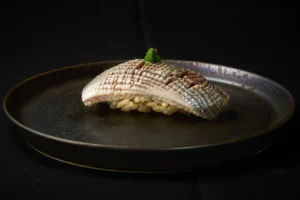
Nothing announces July like shinko, the juvenile of kohada (gizzard shad). The first fish arrive in early-to-mid July, so small that a chef may layer three or four fillets on a single mouthful of shari (seasoned rice). Shinko carries almost no fat at all – which makes it the great exception to the rule above, as well as the clearest proof of it. Its shun is defined by craft: the pleasure lies in texture, in the faint bitterness of silver skin, in the precision of the cure.
That cure is unforgiving. Winter kohada might rest in salt then vinegar for a comfortable stretch; the smallest shinko is cured in minutes – sometimes fewer than ten – because the fillet is thin as paper. The fish also grows week by week through summer, so timing that worked on Monday is wrong by Friday. Chefs re-judge the cure every single morning.
- FilletEach tiny fish is opened by hand – dozens for a single evening’s service.
- SaltA brief salting draws water from the flesh; for early shinko it is a matter of minutes.
- VinegarA short bath in rice vinegar sets the flavour without curing the texture away.
- RestA pause lets salt plus acidity settle evenly before the fish reaches the rice.
By late August the same fish, grown a size, is sold as kohada – still lovely, no longer an event.
Aji: Summer Fat You Can See
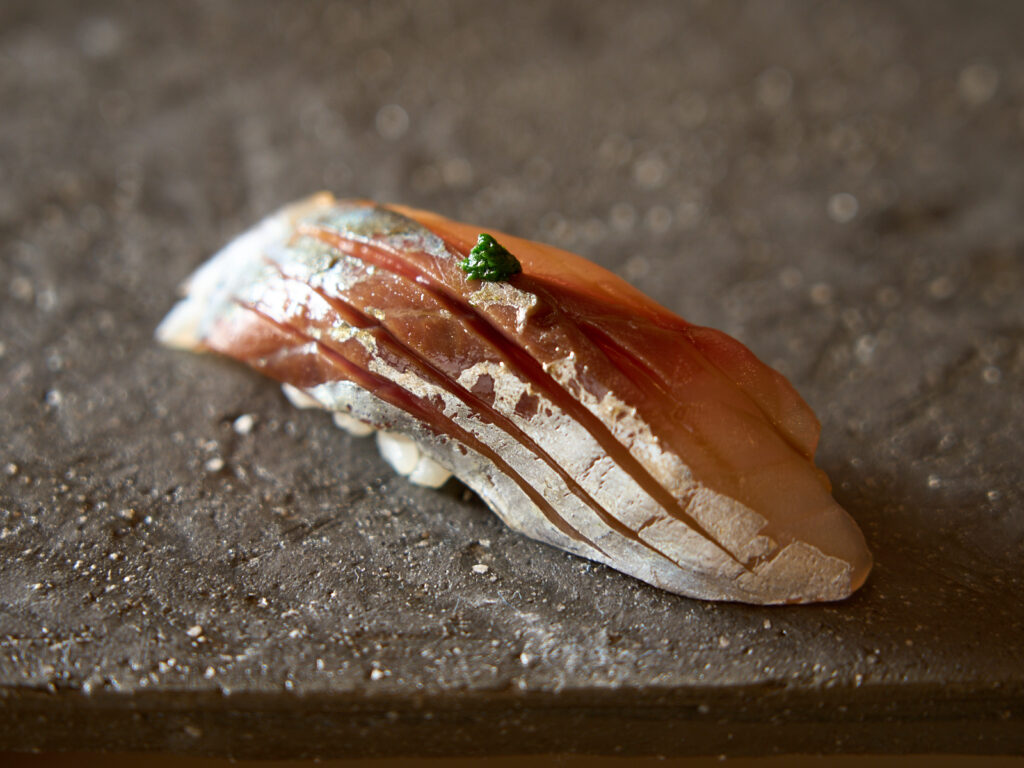
Ma-aji (Japanese horse mackerel) is caught all year round, which makes it the purest test of the shun-as-quality idea: its season is entirely a judgement call. From June through August, coastal aji feeds hard, building the fat that defines its summer character.
You can see the peak on the cut surface. Good July aji shows a faint rosy-gold sheen with fine lines of white fat between the muscle layers; lean fish looks flatly grey-pink by comparison. The classic accompaniment is grated ginger with finely cut spring onion laid between fish plus rice – a pairing that brightens the richness rather than masking it. Older Edomae practice often gave aji a light vinegar cure as well; a few counters still do, which is worth tasting when you find it.
Iwashi: The Rainy Season's Gift
The written character for ma-iwashi (sardine), 鰯, joins “fish” with “weak” – a fish so delicate its flesh begins to slacken within hours. That fragility is why iwashi nigiri was rare in Tokyo a generation ago; the cold chain simply could not deliver it in condition. Today it can, which has restored one of summer’s finest pieces.
The fish to chase is nyūbai iwashi – sardines taken during the rainy season, roughly mid-June to mid-July, when their fat reaches its annual high. At its best the flesh is soft to the point of collapse, rich in a way that surprises anyone who knows sardines only from tins. It takes the same ginger treatment as aji, though many chefs serve it nearly unadorned when the fat is at full tide.
Hamo: Western Japan's Summer, Served in Tokyo
Hamo (pike conger) is the taste of July in western Japan – inseparable from Kyoto’s Gion festival, equally loved across Kyushu. It is a fearsome-looking eel with rows of fine Y-shaped bones that cannot be removed, only defeated. The technique is called honekiri (bone-cutting): the blade slices through the bones at intervals of a millimetre or so – the old benchmark asks for roughly two dozen strokes in every three centimetres – without ever breaking the skin.
In Tokyo, hamo appears at counters as a summer guest. Blanched (yubiki) so the cut flesh blooms open like a white flower, it is usually offered with ume (pickled plum) as an appetiser, occasionally as nigiri. It is also the kind of fish a chef carries with him: Sushi Tanji’s head chef trained in the Edomae school yet keeps roots in Kyushu, where hamo is summer itself.
Reading the Summer Months at the Counter
Put together, the summer repertoire moves like this – arrivals on one side, peaks on the other. A few pieces beyond the four headliners deserve a mention too: anago (conger eel) is at its silkiest in early summer, suzuki (sea bass) suits a light summer treatment, steamed abalone is a quiet Edomae classic of August.
| Month | Just arriving | At its peak |
|---|---|---|
| June | Hamo; the first well-fed aji | Nyūbai iwashi (rainy-season sardine); anago |
| July | Shinko (juvenile gizzard shad) | Aji; hamo; iwashi holding strong |
| August | Early hints of autumn, such as young squid | Shinko grown a size; aji; steamed abalone |
In an omakase you will not order from this table – the chef sets the course. What you can do is ask. A simple “what is at its best today?” is welcomed at any serious counter; in July, asking how many fillets the shinko is running per piece marks you as someone paying attention. The month gives you the cast. The chef, judging fat plus flesh on the day, gives you the performance.
Frequently asked questions
Is July a good month to eat sushi in Tokyo?
Yes – arguably one of the most interesting. July brings the debut of shinko, the juvenile gizzard shad that Edomae chefs treat as the event of the year, alongside horse mackerel at peak fat plus the last of the rainy-season sardines. Counters are cool inside, so the season is felt on the plate rather than in the room.
What is the difference between shinko and kohada?
They are the same fish – gizzard shad – at different ages. Shinko is the juvenile, a few centimetres long, appearing from early July; several fillets may top one piece of rice. By late summer it has grown into kohada, the cured silver classic served year-round. The cure shortens dramatically for shinko, which is why chefs prize it as a test of skill.
Can I ask the chef what fish is in season?
Please do – it is one of the most welcome questions at a sushi counter. Ask “what is at its best today?” rather than requesting a specific species, since a good chef buys by condition, not by list. Many Tokyo counters now offer English guidance, so the question travels well even if you speak no Japanese.
Is hamo served at sushi restaurants in Tokyo?
At some, especially in summer. Hamo is historically a western-Japan fish – Kyoto plus Kyushu treat it as the flavour of July – yet Tokyo counters increasingly offer it as a seasonal appetiser, blanched with pickled plum. Whether it appears depends on the chef’s own background plus what the market offers that morning.
From the guide to the counter
Taste it at our eight-seat counter in Oku-Akasaka.
Classic Edomae craft with careful modern aging – served piece by piece, with English guidance for overseas guests.
Reserve at Sushi Tanji Explore The Tokyo Sushi Guide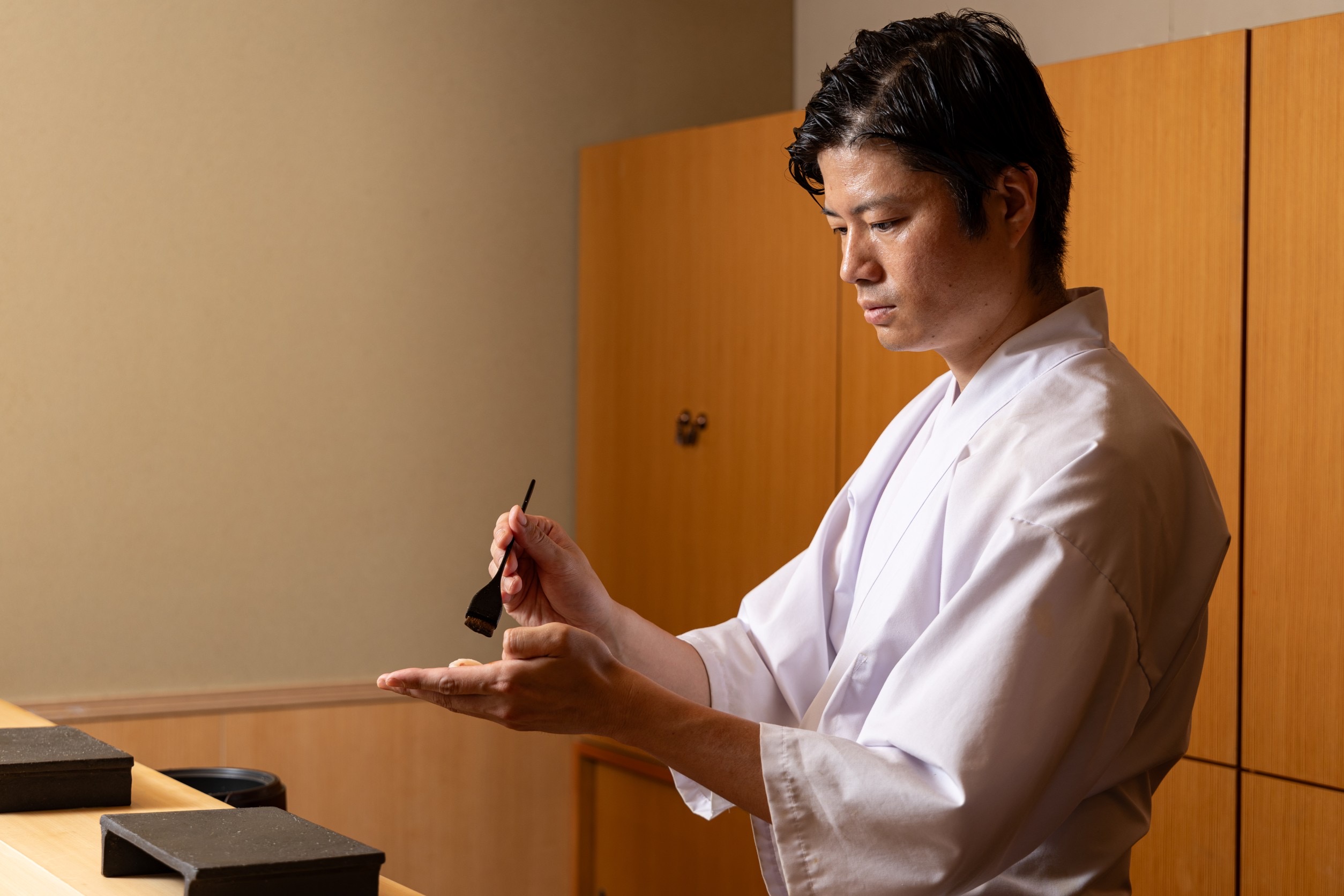
Reviewed by
Tatsuo TakadaHead chef and owner of Sushi Tanji. Trained in the Edomae tradition and rooted in Kyushu, he leads the eight-seat omakase counter in Oku-Akasaka, Tokyo, and reviews The Tokyo Sushi Guide.